Showing posts with label Alberta. Show all posts

Monday, August 21, 2017

Grandpa Lange's Life in Winnipeg and Michigan

We don't know when Grandpa left Essen for Liverpool, or how long he had to stay at a hostel near the docks waiting to board his ship to Canada, but we do know he left England on 12 August 1911 and arrived at Port Huron, Michigan, on the Grand Trunk Railway on 20 August. Assuming 50 to 60 hours for the train ride to Winnipeg, he probably arrived on 22 or 23 August. It's entirely possible he may have been traveling for nearly a month.

The first record I have found for Grandpa in Winnipeg is his and Grandma's Official Certificate of Marriage. Grandpa was a 27 year-old bachelor, who worked as a store keeper, and was a Baptist. His place of birth and parents' name were listed and his father's profession was farming. At the time of his marriage he lived with his maternal uncle, Gustav Ludwig. Grandma was a 21 year-old spinster. (Don't you just love the terminology. Never mind she'd been working since she was 9 years old, no profession was typically listed for women.) She was born in Leduc, Alberta. Her parents' names were also listed.

Gustav and Wilhelmina (Schalin) Lange on their wedding day; personal collection

They were married on 9 April 1915 by C. H. Edinger, a Baptist minister, at the home of Grandpa's uncle at 386 Thames Avenue in Winnipeg. The witness to their marriage was Uncle Gustav. Mom always said Grandma and Grandpa met in Winnipeg or Edmonton when Grandma was there with a family for which she worked. After she and the family returned to Alberta, Grandpa sent her a letter, asking her to marry him and enclosed a train ticket. Not knowing what to do, Grandma asked her boss what he thought. He replied, "Minnie, he sent a ticket. He mean's business. Go."

Current photograph of 386 Thames Avenue, Winnipeg, Canada;
courtesy of Google Maps

In order to track the rapidly growing population of the western provinces, the Canadian government ordered special census of the prairie provinces to begin in 1906. These census were in addition to the nationwide census conducted every ten years on the first year of each decade (example 1911). This practice continued until 1956. Because of this special census we know that Gustav and his young family lived at 400 Thames Avenue just a few doors down the street from Uncle Ludwig. He worked as a general laborer. Grandpa's brother, Traugott (known as Fred), had immigrated to Canada and lived with Uncle Gustav and his family. Aunt Ruth was five months old so the census was likely conducted in July.

Grandpa Lange left Winnipeg in February 1917 and traveled by train to Detroit, Michigan. When he crossed the border on 24 February, he hold immigration officials his destination was 1073 Montclair Avenue, the home of his friend, Dan Stroscheim. Grandma undertook the same train trip with her baby daughter and arrived in Detroit on 30 April 1917.  Her destination was 1090 Holcombe Avenue, where Grandpa now lived.

These delightful photographs of Aunt Ruth were taken at studio in Detroit;
personal collection

On 5 June 1917 Grandpa registered for the World War I draft in Sanilac County, Michigan. He worked as a farm hand for Bert E. Mortimer, who coincidently was also the draft registrar for the county. Mom told me many times Grandma and Grandpa worked on a sugar beet farm, saving money to buy their own farm. Grandpa claimed an exemption from the draft because he was married with dependents. His appearance was described as medium height, medium weight, brown eyes and dark brown hair.

Sanilac County township map and land ownership map; courtesy of
FamilySearch.org and Ancestry.com, respectively

Uncle Walter was born in December of 1917 and Uncle Arnold was born in October 1919. When he was three weeks old, Gustav and his family were traveling once again to a farm Grandpa bought sight unseen in southern Maryland.

_______________

Grandpa Lange's Trip from Essen to Winnipeg
Grandpa Lange's Life in Essen

Monday, October 24, 2016

DNA Discoveries: Who Was Ernestine "Stina"?

In the ongoing, never-ending quest to learn more about my mother's ancestors, she graciously provided a sample for DNA testing less than a year before her death in 2014. When the results were available, the only matches she had that were not very distant cousins were her three children. Since her death, six of my eleven maternal first cousins have tested and another million people have had their DNA at Ancestry. So Mom's match list continues to grow.

Many of my maternal relatives share several matches with people who had a woman named Ernstine "Stina" (Seler) Beich in their family trees. Stina was married to Carl August Beich (1846-1927). Both had been born in what is now Poland and consistently listed their place of birth as Poland or Russia (the borders were ever changing). They considered themselves to be German. Stina or her husband must be related to my Mother and other Lange-Schalin relatives. So I gathered all the information from source documents I could find.

Carl August Beich and Ernestine "Stina" (Zander) Beich;
courtesy of Ancestry member racarroll1

I believe Ernestine to be the youngest child of Johann Gottfried Zander and his wife Anna Susanna Wilde. They were my three times great grandparents as I descend from their daughter Juliane Zander (about 1835-1906), who married Gottlieb Schalin. 

Willamette Valley Death Records; courtesy of Ancestry.com

Ernestine was born in 1846, married and had eight children before she and her family immigrated to Canada in 1893. Carl August Beich and two of the older children, Gustav and Pauline, arrived in Baltimore on 3 June aboard the S/S Weimar. The ship's previous port of call was Bremen, Germany. Stina followed on 10 October aboard the S/S Stubbenhuk.[1] With her were her children, Edward, Adolf, Rudolf, and Hulda. Only two children remained in Russia, their oldest daughter, Amalie "Mollie," who had recently married Heinrich "Henry" Konkel, and their son Julius, who was 11 years old.

Carl Beich returned to Russia in 1899 and returned aboard the S/S Tave with their son Julius, daughter Mollie, her husband, and their three oldest children. They arrived in New York City on 27 April 1899. When the 1900 census was enumerated, Stina, Carl, and their four youngest children lived in Caledonia Township, Wisconsin, where Carl owned a farm. Their son, Julius, also worked on the family farm.

On 17 November 1908 Rudolf, homesteaded land in Bruderheim, Alberta, Canada. Two years before, he had homesteaded another piece of land but abandoned it because the land "wasn't was good represented to me." By 1916 Stina and Carl lived in Bruderheim. None of their children lived with them and Carl's occupation was listed as retired farmer.

Declaration of Abandonment for Rudolf Beich; courtesy of Ancestry.com

Stina and Carl traveled to Salem, Oregon, several times in their later years to visit their children who lived there. Perhaps it was on a similar trip that Ernstine (Zander) Beich died as her death occurred on 20 August 1917 in Salem. She was interred in the Lee Mission Cemetery.

Carl continued to live in Bruderheim and traveled to see his children in Wisconsin. He died on 11 October 1927 in Merrimac, Wisconsin and was interred in St. John's Evangelical Lutheran Cemetery.

Their children:
  1. Amalie "Mollie" Beich born 1871; died 25 October 1945; married Heinrich "Henry" Rudolf Konkel
  2. Gustav Beich born 1874; died 1964; married Anna Behnke
  3. Pauline Beich born about 1877; died 1908
  4. Eduard or Edward Beich born about 1881; died before 1900
  5. Julius Beich born 31 December 1882; died 4 March 1959; married Ida A. Messer
  6. Adolf or Adolph Beich born 12 January 1886; died September 1962; married Grace Staudenmayer
  7. Rudolf or Rudolph Beich born 20 February 1887; 23 March 1972; married Anna Krause
  8. Hulda Beich born 18 December 1891; died 19 June 1973; married 1) Charles Edward Haughey and 2) Samuel Edward Alexander
Solving Stina's correct surname and her parents connected my Mother, siblings, cousins, and me to nine new cousins!

_______________
[1] Some of my Schalin family and their fellow church members immigrated to Canada on the S/S Stubbenhuk the same year.

Wednesday, July 6, 2016

Homesteader Recipes: Rabbit Stew and Dumplings

When my great grandfather, Wilhelm Schalin, immigrated with his wife and children to Alberta, Canada, from Russia (now Ukraine), they came with several other members of their church and settled south of Edmonton in a place they named Fredericksheim. An Indian reservation had been cleared and land was available to homestead. The Canadian Pacific railroad only went as far west as Winnipeg so they had to travel another 800 miles by horse and wagon.

Once they settled on the land they homesteaded, they had to clear it, survive the coming winter, and begin farming the next spring. During the winter, the families survived on rabbits they trapped and flour sent by the government from Winnipeg. The following recipe for rabbit stew and dumplings is a typical recipe from Fredericksheim's pioneer past.

Rabbit Stew and Dumplings

1 rabbit
1/2 cup flour
1/2 teaspoon salt
dash pepper
1/4 pound salt pork
1 large onion
1/2 medium turnip, sliced
3 carrots, quartered
3 potatoes, quartered
salt and pepper to taste
dumplings (see page 94)

Soak rabbit overnight in cold water. In the morning dry meat well. Cut into serving pieces. Dredge in flour; sprinkle with salt and pepper. Cut pork and fry in skillet. When pork is nicely browned, remove pieces to stew pot, leaving fat in skillet. Put the pieces of rabbit in hot fat and brown on both sides. Remove to stew pot with enough water to cover meat. Simmer for 1-1/2 hours or until tender. Add vegetables and simmer until done.

15 minutes before vegetables are tender, drop in the dumplings, cover tightly. Cook for 20 more minutes.

Feather Dumplings

2 cups flour, sifted
1 teaspoon salt
4 teaspoons baking powder
1/4 teaspoon pepper
1 egg, well beaten
3 tablespoons butter, melted
2/3 cup milk

Sift dry ingredients. Add egg, melted butter and enough milk to make moist, stiff batter. Drop by teaspoon in to hot water or simmering stew. Cover tightly and cook 20 minutes.

These recipes are from the book, From Pioneer Kitchens: 100th Anniversary, which was collected and published by Southern Alberta Pioneers and Their Descendants.

Book has been digitized by the Alberta HeritageDigitization Project

Friday, April 29, 2016

My BIG Brick Wall: Augusta Fabrizius

When I checked my Ancestor Score a couple of months ago, I knew 15 of my 16 great great grandparents. The reason I don't know all of them is my BIG brick wall is my great grandmother, Auguste Fabriske / Fabricius / Fabrizius, who I know next to nothing about.

My pedigree chart; image courtesy of Ancestry.com

I know from ship passenger manifests that she was born about 1861; that she married my great grandfather, Wilhelm Schalin, on 20 December 1881 (converted from Julian calendar); lived in an area of Tsarist Russian that is now Ukraine; had six children there before immigrating to Alberta, Canada; had three more children; and died on 12 February 1898. Other documents to support these facts include the registration of a daughter's birth, which provided the marriage date; a list of headstone transcriptions of the people buried in the cemetery of the First Baptist Church of Fredericksheim in Leduc, Canada; and a book written by Lucille Marion (Fillenberg) Effa, entitled Our Schalene Family: 1770-2003. Mrs. Effa was my second cousin once removed.

The birth registration of daughter, Wilhelmine Schalin, who was born in 1892, is in Russian. The document includes middle names for the parents -- Wilhelm Gottlieb Schalin and August Wilhelmowa Fabrizius. It is the only record which includes middle names for my great grandparents. My current belief is that they are not middle names but rather patronymics. Wilhelm's father was Gottlieb Schalin. If so, then Auguste's father's name was Wilhelm Fabrizius -- the only chip in my brick wall.

Most of this information was included Mrs Effa's book. I found the few documents I have about Auguste as I conducted by own research to verify and extend the information in the book. Late last year I hired professional researchers to assist me break through the brick wall that was Auguste Fabrizius. However, they found so many documents about the Schalin family in Poland, where they lived before moving to Russia/Ukraine, that we concentrated our search there. So I am saving the Ukrainian research for another day.

_______________
Ancestor Score and 500th Post
Deciphering Cyrillic: Finding Tuchyn
Fleeing a Tsar
Starvation Faced Fredericksheim
History of Fredericksheim
Fearless Females: Religion

Monday, May 11, 2015

52 Ancestors #19: 1949 Road Trip

Ancestor Names: Gustav LANGE (1888-1963), Wilhelmina (SCHALIN) Lange (1894-1960), Dorothy Ailein (LANGE) Jennings (1930-2014)

My mother was the eighth of nine children born to Gustav and Wilhelmina (Schalin) Lange. Grandpa immigrated to Canada in 1911 at age of 23, and Grandma was the first child born to her parents after they immigrated to Canada in 1893. Gustav and Wilhelmina married in Winnipeg in 1915, moved to Michigan in 1916, and purchased a farm in southern Maryland in 1919. Their last six children were born on that farm.

In 1949 my Mom and her parents drove from Maryland to Alberta, Canada to visit family my grandparents hadn't seen in over 30 years. Mom's sister, Millie, may have accompanied them, but I do not know for sure. Mom would mention the trip from time to time; and as we were clearing out her house prior to selling it, she reminisced as we went through old photograph albums.

Somewhere in the United States on the way to Montana, 1949; Mom is on
the left. From my personal collection

Oh, how I wish I would have been in family historian mode and asked questions about the people in the photographs and the places they saw along the way. But I didn't. I was project manager mode. I was working to a schedule, checking things off the task list, and trying to keep Mom excited about her decision to move into an assisted living facility.

These photos were taken in Montana. To the left Grandpa Lange is
is in the light shirt holding a cup. It looks they were watching a
living history demonstration of some sort. On the right (left to right)
are Grandpa Lange, Grandma Lange, her sister Hilda Wendell and
John Wendell. From my personal collection

A small digression so you may appreciate why I focused on the route my Lange/Schalin ancestors took on that Summer of '49 road trip...

My husband says my family can't be together for 5 minutes before a map is out; and we are tracing routes for possible vacations, reliving old vacations, or answering a geographical question that has come up in conversation. He is simply amazed by the phenomena and we never let him down. It's genetic we abashedly tell ourselves as one of us is going to get a map.

So how did Mom and my grandparents drive to Canada? I know they drove because they took Mom's new car and that she and Grandpa did the driving. From the photograph albums I know the relatives they visited.  Grandma's sisters Aunt Hilda in Livingston Park, Montana, Aunt Julia in Red Deer, Alberta, and Aunt Lena and Grandpa's brother Richard Lange in Winnipeg. They also saw Grandma's sister, Aunt Martha, but I believe she and her husband drove west or took the train from Ontario for the visit. They also stopped in North Dakota to visit the Tridtke or Fridtke family, but I do not know who they are.

Shell Oil map of Saskatchewan and Manitoba. Part of the route my Mom
and Grandparents drove in 1949 on an extended family visit.

I have acquired a 1945 map published by the the Canadian Government Travel Bureau of the main automobile routes between the United States and Canada (Eastern Sheet), and Shell Oil maps of British Columbia and Alberta and Saskatchewan and Manitoba published about the same time period. Based on the order of the photographs in Mom's album, I believe the route of their trip was Montana, Alberta, Manitoba, and North Dakota and back to Maryland. Using modern roads the trip is just over 5,500 miles. They were on the road for just over two months.

This photograph was taken in Red Deer, Alberta, likely at the home of
Julia (Schalin) Kirkham. Grandpa Lange is at the far left, then Felix George
Allen, my Mom, her Aunt Martha (Schalin) Allen, and Grandma
Lange; From my personal collection

Mom and I are different in another way as well. I used to come back from vacation and none of my photographs would include a person. It's only since I've become interested in genealogy that I may remember to photograph people. Mom's photographs rarely included the sights they saw along they way; they are all of people. Family were always in her heart. When her minister gave the eulogy at her memorial service, he told such moving stories of Mom's childhood; it was almost as if he was her brother and grew up along side her. Those were the stories she'd told him about her family over the nearly 30 years they knew each other.

And so one last photograph from Mom's album of their 1949 road trip.

According to Mom's album this photograph was taken in Winnipeg,
the home of Pauline "Lena" (Schalin) Parsons. I assume these men
are Parsons/Schalin family but I have no idea who they are. From my
personal collection

This is my entry for Amy Johnson Crow's 52 ancestors in 52 weeks challenge optional theme There's a Way.

Sunday, April 19, 2015

52 Ancestors #16: 106th Birthday "Girls"

Ancestor Names: Minnie Hazel (GORDON) Greenlee (1885-1992), Ruth Marion (SCHULTZ) Falkenberg (1881-1987), Susana Bertha Amelia (TALMON) Amsberry (1892-1998)

The person who lived the longest in my tree was Henry Roy Tucker. He lived to be 107 years old and was the fourth cousin twice removed of my sister-in-law. I've written about him before. So I decided to write about the next oldest person. It turns out there are three women who share the honor. Without getting into months and days, let's just say they all lived long enough to see their 106th birthday and leave it at that.

Minne Hazel (Gordon) Greenlee

Minnie was the wife of my fourth cousin twice removed, William Francis Greenlee. She was born on 28 November 1885 in St. Paul, Nebraska, which is located in the Loup valley. St. Paul was established by two surveyors, struck by the beauty of the land, in 1871. Minnie married William Greenlee at the age of 19 in her hometown. They had eight children who lived to adulthood. Her husband became the editor of the newspaper in Oshkosh, Nebraska. He died in 1968 and Minnie died in 1992. They are buried at Oshkosh Cemetery.

Grave site of William and Minnie (Gordon) Amsberry; photograph by
Find a Grave member Debbie McGinley

Ruth Marion (Schultz) Falkenberg

All I know about Ruth comes from a book, Our Schalin Family, by Lucille Fillenberg Effa. Ruth was born on 2 June 1881 and died on 25 August 1987. She married Rudolph Falkenberg, my first cousin twice removed. They had three known children. Rudolph emigrated from the Volyn region of Ukraine (at the time part of the Russian Empire) on 9 May 1893 aboard the S/S Stubbenhuk. His family traveled with a group of other German Baptists to the Fredericksheim area of Alberta, Canada. Rudolph died on 29 August 1940 at the Royal Alexandra Hospital in Edmonton. He was a truck driver at the time of his death and was buried at Beechmount Cemetery, also located in Edmonton. Ruth died forty-seven years later on 25 August 1987.

Susana "Susie" Bertha Amelia (Talmon) Amsberry

Susana was born on 18 April 1892 in Cheyenne County, Kansas. Her father was a farmer, who had immigrated from Germany. Susie married Alfred Lee Andrew Amsberry on 2 August 1909 in Benkelman, Nebraska. He was my fourth cousin twice removed. They had twelve children with eight surviving childhood. Alfred was a truck driver in 1940. He died in 1965; Susie, in 1998. Both are buried at Benkelman Cemetery in Benkelman, Nebraska.

Susie (Talmon) Amsberrty and her husband, Alfred, and some of their
children; photograph courtesy of Ancestry.com member igoodwin165.
Susie and Alfred are on the far right.

This is my entry for Amy Johnson Crow's 52 ancestors in 52 weeks challenge optional theme Live Long.

_______________
Celebrating a Centenarian: Henry Roy Tucker
Sunday's Obituary: Kathreen Estelle (Gibson) Hecker Huntley Glatfelder
Honoring a Centenarian

Sunday, January 11, 2015

52 Ancestors #2: Fleeing a Tsar

Ancestor Name: Wilhelm Schalin (1859-1952)

We know the Schalin family considered themselves German, but we have no idea from where in Germany they originated. Wilhelm Schalin's great grandfather married Anna Dorothea Rosnian in 1791 at Wladylawowo, Poland, which is located on the shores of Gdansk Bay. Prussia, Austria, and Russia had taken chunks of the country in 1772 in what became known as the first Polish partition. In and 1795 the three countries partitioned Poland again until it was erased from the maps of Europe.

Wladylawowo, Poland, the first reference of the Schalin family in Poland

When Prussia took over their Polish territories, they discovered about 1,500 German villages had already been established. During Prussia's rule, they established more settlements. In 1806, Napoleon created the Duchy of Warsaw. But it was short lived. Russia pushed Napoleon out of Poland in 1812-1813. In 1815 Congress Poland was created, but its foreign affairs were controlled by Russia. Portions of Poland that were under Austria's control were added to Congress Poland and German settlement spread to those areas. By the mid 1800s, there were about 325,000 Germans living in what is now Poland's western half of the country. In 1831 there was a Polish uprising and Russia took full control of the country.

Russia had also acquired the Volhynia region of what is now Ukraine during the Polish partitions and controlled its destiny for 120 years. The vast areas of the region were largely unsettled wilderness which had never been cultivated by its former owners, Polish nobility. In 1862, Tsar Alexander II freed the serfs from the land and many left the farms for better work opportunities. The Boyar landowners were left with large tracts of land but no workers and no income from the land. The owners encouraged Germans living in Poland to lease their land. The Germans responded in large numbers. In 1861 there were less than 5,000 German families living in Volhynia. By 1915 there were 235,000 families. Wilhelm's father, Gottlieb Schalin moved his family to Volhynia between 1861 and 1863.

A German farmhouse in Volhynia; photograph courtesy of Lucille Fillenberg Effa

In 1881 Alexander III became tsar of Russia. Unlike his father, he was very conservative and reversed several of his father's liberal policies. He believed the country could only be saved by the political ideal of single nationality, language and religion. He attempted to realize this ideal by mandating the teaching of Russian throughout the empire, outlawing any other religion but Russian Orthodoxy, and weakening foreign institutions in whatever manner possible. Alexander III rescinded the ban on German men serving in the Russian army and levied new taxes on German communities. By this time many of the Germans living in Volhynia were German Baptists. Their religion was outlawed and their ministers arrested.

Wilhelm Schalin, my great grandfather

Wilhelm Schalin decided it was time to leave Volhynia. His family and several others traveled to Liverpool, England, and boarded the S/S Sarmatian on 21 April 1893. They arrived at the port of Quebec on 4 May 1893 and traveled by train to Winnipeg, Manitoba. After purchasing needed supplies, the families continued west and homesteaded land in the Leduc area of Alberta, Canada, which at the time was part of the North-West Territories.  Wilhelm Schalin homesteaded section SW15-T49-R24-W4. A year later my grandmother was born on 23 May 1894.

S/S Sarmatian

And that's how my Schalin family came to live in Canada.

This is my entry for Amy Johnson Crow's 52 ancestors in 52 weeks challenge optional theme King.

_______________
This post was originally published on 27 March 2014.

Starvation Faced Fredericksheim
History of Fredericksheim
Fearless Women: Religion
Differing Memories or Family Reunions Can Be Dangerous

Thursday, December 18, 2014

Starvation Faced Fredericksheim

This story was adapted from a letter written by Ed C. Jeager and appeared in the book entitled From the Frontier Days in Leduc and District, which was published by the Leduc Historical Society to commemorate Alberta's 75th anniversary.

As the last forms were being locked up for this book a letter came from Mr. Ed. C. Jaeger telling of pioneer days at Fredericksheim, and that goes back to 1893 when Rev. F. A. Mueller led a group of Russian settlers into that district, first white homesteaders southeast of Leduc. There were the Falkenbergs (two families), Schalins (two families), Bienert, Hammer, Hiller, Boelter (or Belter), Khunert, Klatt, Roth and a few others. The colony faced actual starvation when the federal government and Winnipeg people sent flour, for rabbits then had a disease that made them unfit for food. Rev. Mueller tried valiantly to comfort his lamenting, homesick colony, predicting great things if they only stayed and had faith in God.

A German farmhouse in then Volhynia, Russia; photograph courtesy of
Lucille Effa Fillenberg

So most of the settlers braved the adversities and after many years their faith was more than justified for it's a fine district today. Later immigrants, also from Russia, were terrified at the echoing howls of the coyotes, which they were told were prairie wolves, and two men without families and with pocket money started walking back. They were Muth (Courage in German) and Froelich (Happiness in German) and they finally made it to Winnipeg overland but with shoe soles gone. The remainder of the newcomers stayed with Rev. Mueller and his people, only because they and no money to return to the old land, where they had left good homes. Later on they could laugh at their troubles, as had a Mr. Hiebert from Oregon who came on the same twice weekly train to Leduc and thought it highly amusing that men named Courage and Happiness were wailing louder than the coyotes they were afraid would eat them alive!

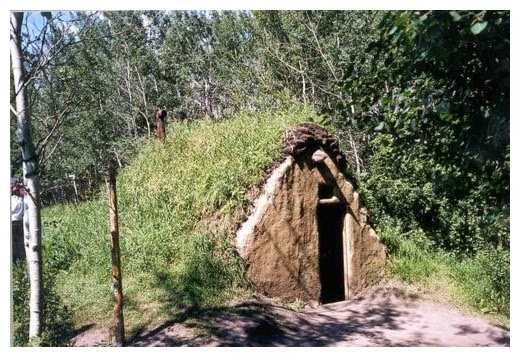
Typical southern Alberta pioneer home; photograph courtesy of Norm
Kerychuk

It's quite different from the homes they left in the Volhynia region of what was then Russia don't you think?

History of Fredericksheim
Fearless Females: Religion
Fearless Females: Immigration
Being German in Tsarist Russia: Why They Left
Moving Halfway Around the World in 1893

Tuesday, December 16, 2014

History of Fredericksheim

This story was written by Rudolf Grunwald, a distant cousin, and appeared in the book entitled From the Frontier Days in Leduc and District, which was published by the Leduc Historical Society to commemorate Alberta's 75th anniversary.

My Schalin great grandparents immigrated to the Leduc area of Alberta in May 1893 and settled in the area that became known as Fredericksheim. My grandmother was their first child born in their new country.

My great grandfather, Wilhelm Schalin. Personal
collection.

Rudolf Grunwald's story movingly tells why they came and the hardships they faced:

"Our parents left middle Europe for various reasons. Among the complaints were overcrowded conditions, lack of personal and church freedom and generally poor government. Owing to the ban on religious gatherings the church sent Rev. F. A. Mueller to Canada to look around for a place in which their people could locate. Upon his return to the Old Land he recommended the district of Leduc in the far off Northwest Territories of Canada. Thus the first group of settlers landed in Leduc in the spring of 1893, homesteading nine miles southeast of the depot and railway siding that then constituted the place called Leduc. The second group of settlers arrived in the fall of 1893 and took up land in the same locality as the first group.

Needless to say there were no roads, only deep-rutted wagon trails winding through the timber from house to house, and the wagons being drawn mainly be oxen, with scarcely any horses in the new community. Much of the moving about was done on foot. But gradually small clearings were chopped out of the bush and attempts made at growing wheat and coarse grains. At the first early frosts and even snowstorms ruined most of the grain, especially wheat, and flour had to be ground from the frozen darnels. First threshing was by means of flails, or by having horses trample on the straw on frozen ground, after which it was thrown against the wind to remove the grain from the chaff. It the spring grain was sown broadcast by hand and covered with harrows or brush drags. Not many years went by however before improvement was made in seeding equipment and a horse-powered threshing machine was secured to take care of enlarged fields, and within a few seasons steam-powered threshing engines were brought into the settlement.

A German farmhouse in then the Volhynia region of Russia; photograph
courtesy of Lucille Effa Fillenberg

The first dwellings at Fredericksheim, as in other parts of the entire Leduc district, were made of logs but instead of sod such as most other settlers used, the German immigrants often thatched their house roofs with straw and hay but there were no windows at first and heat came from open fireplaces built of clay. Hardships were common and constant. Quite often families had to live without any bread or flour for two or three weeks at a time, the main food supply being the native rabbits. These were caught by digging deep holes on rabbit trails or near hay stacks and covering the top with logs and wild hay which the animals dearly loved. The only work available for the men was whip sawing lumber by hand for which the going wage was $0.25 a day, the workman providing his own grub.

Bush fires were frequent until the wet seasons came along in 1899, and while the fires helped clear the land they often got out of hand and all night vigils were necessary to save the log buildings. The first settler was John Frederick and after the first school was built about the close of the last century the district was named Fredericksheim in his memory. The first church was build in 1894 of hand sawn lumber with Rev. F. A Mueller as pastor. The first dinner guest was a big black bear which came out of the woods to investigate a kettle of rabbit stew cooking over an open fire. It's worthy of note that many of the settlers in Fredericksheim took up homesteads that had been filed earlier and abandoned by people from Ontario, Minnesota and the Dakotas. The first teacher in the Fredericksheim school was Charles Richardson.

Photograph taken in 1903 in front of the First Baptist Church in
Fredericksheim. My great grandfather helped build the church;
photograph courtesy of Lucille Effa Fillenberg

Fearless Females: Religion
Fearless Females: Immigration
Being German in Tsarist Russia: Why They Left
Moving Halfway Around the World in 1893

Sunday, September 28, 2014

52 Ancestors #39: 1946 Pittsburgh Steelers

Ancestor Name: KLAPSTEIN, Earl Loren (1922-1997)

My Schalin ancestors immigrated to Alberta, Canada, in 1893, primarily to escape the religious intolerance of Russian Tsar Alexander III. My grandmother's aunt, Pauline (Schalin) Falkenberg, married John Gutche soon after the extended Schalin clan arrived in Alberta. He was her second husband. They had five children between 1895 and 1906.

In 1917, their oldest daughter, Sadie Pauline Gutche, married Emil Klapstein. Emil's family was also from Russia and had immigrated to Alberta about 1898. Soon after their marriage they moved to Lodi, California. Emil worked as a manager at the Enterprise Planning Mill and they lived at 523 East Walnut (which is now a parking lot).

Sadie and Emil had three children: Harvey Cecil, Vernon Sidney, and Earl Loren. Vernon later changed his surname to Kenwood. Earl played college football in California at the University of the Pacific and was a member of the university's ROTC program. He served with the U.S. Marine Corps during World War II and was later drafted by the Philadelphia Eagles in the 24th round (250th overall) in 1944.

Earl Klapstein in 1943; photograph courtesy of Fanbase

By 1946 he was playing offensive and defensive tackle with the Pittsburgh Steelers. The team went 5-5-1 under head coach, Jock Sutherland, who was later inducted into the Football Hall of Fame in 1951.

1946 Pittsburgh Steelers; photograph courtesy of Tailgating Jerseys

In 1956 he was a defensive line coach and scout for the Green Bay Packers; it was his move up to the coaching ranks of professional football. He didn't stay in Green Bay long. According to an Associated Press card, he became the Director of Physical Education and head football coach at California Junior College in Cerritos soon after it was founded.

Racine Journal Times, 20 April 1956

Earl married Viola C. Wiederrich, on 7 May 1944 in Nevada. He had just completed basic training at Parris Island, South Carolina but had not yet been deployed to the Pacific. They made their home in Lodi most of their entire lives. Viola was a fine athlete in her own right. She played shortstop on a championship softball team in 1939. Earl died in 1997 and Viola in 2009. Both are buried at Cherokee Memorial Park in Lodi.

I discovered Earl Klapstein after having my mother's DNA tested. I wanted to be able to identify which of my DNA matches came from each parent. I also know so little about my mother's side of the family, I was hopeful a test one generation further back would be helpful. One of her 4th to 6th cousin matches had no family tree attached to the test, but I recognized the surname of the person who administered the test from a one-place study I had done of Leduc, Alberta, Canada -- where my Schalin ancestors settled in 1893. I messaged him and we've since shared enough information for me to place him in my family tree. According to my tree software he is the grand nephew of the husband of a first cousin twice removed. That means that from my known information we are not related by blood. So there must have been a Klapstein-Schalin marriage in Russia about which we are both unaware.

This is my entry for Amy Johnson Crow's 52 ancestors in 52 weeks challenge.

Fearless Females: Immigration
Fearless Females: Religion

Friday, May 23, 2014

52 Ancestors #21: Wonder Woman

Ancestor Name: Wilhelmina (Schalin) Lange

We read so much today about super Moms and wonder women who do it all -- work, raise children, and put meals on the table. I'd like to introduce an original of the species on the 120th anniversary of her birth.

Wilhelmina (Schalin) Lange was my maternal grandmother. She raised all her nine children to adulthood and each one thought they were her favorite. She was an amazing woman. In the late 1990s Lucille (Fillenberg) Effa contacted my father through a genealogy forum. She was writing a book on my grandmother's Schalin family and wondered if my mother would contribute an article about her mother. So on the 120th anniversary of my grandmother's birth, I thought I would let my Mom tell the story of her beloved mother's life. This excerpt is from Our Schalin Family: 1770-2003, by Lucille Fillenberg Effa, published in 2003 by Northstar Direct Printers, Nanaimo, British Columbia.

by Dorothy (Lange) Jennings:

Wilhelmina "Minnie" Schalin, daughter of Wilhelm and Auguste (Fabriske) Schalin, was born in the Fredericksheim district east of Leduc, in the year following the Schalin family's arrival in Canada. She was their second daughter to be named Wilhelmine and was only three years old when her mother died. A year later her father remarried.

Minnie had a very unpleasant childhood and when her father found out how she was being treated he would take her with him when he went out into the fields to work. When she was about nine, her father found another family to keep her where she helped out with farm chores. When older she helped in homes when a baby was born. At one time she worked in hotel kitchen and for a time was employed by Lord and Lady Davis in Edmonton, Alberta.

Wilhelmina Schalin when employed by Lord Davis

Minnie met Gustav Lange while living in Edmonton. When he moved to Winnipeg, Gustav sent her train fare to come there to be married and the of 9 April 1915 was chosen.

Gustav was born to August and Karoline (Ludwig) Lange, in Rozhishche, near the city of Lutzk, in Volhynia. He moved to Germany in 1906 where he worked for a short time before leaving for Canada. He sailed from Liverpool, England, on 12 August 1911 onboard the S/S Teutonic and arrived at the port of Quebec on the 20th.

Wilhelmina (Schalin) Lange on her wedding day

Their first daughter, Ruth, was born in February of 1916. The family left Winnipeg, crossing through Detroit on 30 December 1916 to live in Peck, Michigan. Two sons, Walter and Arnold, were born there while the family worked as share croppers on a sugar beet farm. Another move was made to Cheltenham, Maryland in November 1919 when Gustav saw an advertisement for a farm for sale in Maryland. They left by train when Arnold was only three weeks old. Before leaving for Maryland, the baby had to have an operation to correct a harelip, necessitating a stop in Buffalo, New York, to have the stitches removed by another doctor.

Ruth Hedwig Lange, Wilhelmina's oldest child; photograph taken in Detroit, Michigan

They bought the farm in Maryland where six more children were born to them. They worked hard cutting pulpwood to pay for the farm and build a new home. They raised tobacco for one year (a big money crop in Maryland) but because of religious beliefs did not pursue that further. Instead, they later started a poultry business and also kept horses, cows and pigs. Gustav began an egg route in Washington, DC, delivering eggs to some of the U.S. Senators in the Senate Office Building.

Tribute to Gustav and Wilhelmina (Schalin) Lange, carved in a tree by their son, Arthur James Lange

Minnie's life was busy and she worked hard raising nine children and working side-by-side with Gustav on the farm. They had no electricity or running water. Although there was always a lot of work to be done, she found time to play with her children: tag, hide and seek, and ball games, even putting boxing gloves on to box with Alfred! She had gift of story telling. When she worked with the children cutting and husking corn, fixing the road, hoeing the garden, planting potatoes, bringing in the hay, feeding chickens, or whatever, she would tell them a story and magically the work was done.

Wilhelmina (Schalin) Lange in her beloved rock garden; how she had time for it no one knows

Meal times were the best part of the day, although presenting a real challenge for her. She relied on the big garden and fruit trees to put a meal on the table. These were noisy, but cheerful times.

In many ways she was a perfectionist. For example, if the girls didn't hang the clothes on the line according to size and color she would make them go back out and change it. She was a good seamstress and could do delicate handwork. It was amazing to see those big hands, which wielded an axe to cut firewood doing the finest handwork with a little needle.

Wilhelmina (Schalin) Lange doing fine embroidery

Minnie took every opportunity to instill good work ethics and Christian ideals in her children. She provided them with many happy childhood memories and all of her children feel truly blessed to have had her for a mother.

She predeceased her husband by three years, passing away 27 November 1960 in Clinton, Maryland. Gustav Lange died on 23 December 1963 in Arlington, Virginia. Both are buried in Waldorf, Maryland.

This is my entry for Amy Johnson Crow's 52 ancestors in 52 weeks challenge.

________________
Wilhelmina "Minnie" Schalin was born on 23 May 1894 near Leduc, Alberta, North-West Territories, Canada, to Wilhelm and Auguste (Fabriske) Schalin. She was their seventh child and the first to be born in Canada. She married Gustav Lange on 9 April 1915 at Winnipeg, Manitoba, Canada. On 30 December 1916 they immigrated to Peck, Sanilac, Michigan. They lived there for three years before moving to Cheltenham, Prince George's, Maryland. They had nine children. Wilhelmina died on 27 November 1960 at Clinton, Prince George's, Maryland. She is buried next to her husband in Trinity Memorial Gardens at Waldorf, Charles, Maryland.

Sunday, May 4, 2014

52 Ancestors #18: Biking Across Western Canada in 1930

Ancestor Name:  William Warm

I have blogged about the adventures of William Warm before, which included stealing a train during World War I; he was the husband of my second cousin once removed. William and his family arrived in Canada on 27 August 1927 aboard S/S Seydlitz. With the help of Rev. Emil P. Wahl of the American German Baptist Mission, the family made their way Winnipeg, Manitoba to help harvest a bumper crop of grain in southern Saskatchewan and Alberta. Bill decided to stay and try his hand at farming. After a few years of battling dust storms and other crop failures, Bill realized farming in that area of Canada was not for him.

He took off on 30 July 1930 on the one-speed Opel bicycle he brought with him from Germany and headed for Vancouver to look for his uncle, Dave Janzen. The description of the trip is included in Lucille Fillenberg Effa's wonderful book, Our Schalin Family: 1770-2003. I've included an excerpt here:

"He reached Calagary sooner than expected so carried on to Banff, before stopping for the night beside a river, near the roadside. Bill's slumber under the stars was soon interrupted by a bear attempting to ransack his rucksack. Thankfully, the furry thief was scared off when Bill jumped up abruptly and shouted at it.


Photograph of Bill's Opel bicycle during his trip across western Canada.
Photograph taken by William Warm

West of Banff, he headed south through the Windermere valley to Cranbrook, then west to Creston where he crossed the Arrow Lakes by ferry, at a cost of $0.05. Leaving Nelson, he continued his journey pedaling through the West Kootenays. Arriving at the foot of the 12-mile long hill outside of Rossland a kind soul in a Ford touring coupe stopped and offered him a rope tow. Bill accepted the offer but made the mistake of tying the rope to the spare tire on the back of the car. His second mistake was tying the other end to the bike's handle bars. Up, up, up they went through many switchbacks, before reaching the crest of the hill -- at least a half hour's grind. But as the law of gravity would have it, what goes up soon comes down -- rapidly. Bill, pell-melling behind, shouted for the driver to stop. He did. But Bill zoomed right on by, only coming to an abrupt halt in the ditch when the rope length ran out and snapped. After picking himself up, he immediately noticed the bicycle wheel now in the shape of a figure eight. What to do? He took the wheel off, picked it up, and bent it back into shape across his knee, reinstalled the wheel and carried on, declining an offer for further towing.

Interesting escapes weren't yet over. Upon arriving in Grand Forks, Bill was greeted by a bevy of stark-naked ladies protesting something as they paraded about the town trying to make a political point. Thankfully, this occasion was not planned for Bill so he kept on pedaling by, leaving the local RCMP officers to handle the problem presented by a group of Russian Doukabour 'mommas.'

Bill eventually arrived in Vancouver but still had to find Uncle Dave, without an address nor a phone number, but knew he lived on Lulu Island somewhere. Bill remembered having seen an advertisement for the Ebenezer Baptist Church in the German magazine Der Sendbote. He found the church on 52nd Avenue near Fraser Street. As it happened the pastor, Rev. Fred Mueller (son of Rev. F. A. Mueller[1]) knew Uncle Dave and directed Bill to his home.


William Warm and his Opel bicycle

Thus ended Bill's long journey sometime in August 1930. He averaged over 70 miles a day, and more amazing, never had one flat tire."

This is my entry for Amy Johnson Crow's 52 ancestors in 52 weeks challenge.

_______________
William Warm was born on 13 Dec 1909 at Millirowa, Russia, to John and Helen (Janzen) Warm. After being displaced several times during World War I and afterwards, the family arrived in Nova Scotia, Canada, aboard the S/S Seydlitz on 27 August 1927. William married Norma Viola "Minnie" Grapentine on 6 October 1936. He died on 26 Aug 2007 at the age of 97.

To read more about William Warm's early life and journey from Odessa to Vancouver, including stealing a train, click here.

[1] Rev. F. A. Mueller was the German Baptist minister responsible for bringing several families from the Volhynia region of what was then Russia to the Leduc area of Alberta, Canada, including my maternal grandmother's Schalin family.

Wednesday, April 30, 2014

Genealogy Happy Dance of the Year...Maybe the Decade

A Kiwi cousin, a virtual friend from Scotland I met on a Formula One racing forum, and pure serendipity have me doing the genealogy dance of the year...maybe the decade.

A few weeks ago my Kiwi fourth cousin once removed emailed me with questions about my great great grand aunt, Christina Semple. We knew she was born in 1860 and my cousin surmised she had immigrated to Canada and died there. She had found some memorial monument inscriptions from Dalserf, Scotland, where the family lived. But the inscription we thought was for our Semple family confused the heck out of us because it referenced someone who neither of us had in our Semple tree. The inscription read as follows:

Erected by Alexander Fulton in memory of his [illegible] aged [illegible]4 years, his daughter [illegible] died 15th March 1903 aged 46 years. Also the above Peter Semple died 29th March 1904 aged 82 years. Also John Semple his eldest son died 4th February 1914 aged 67 years. Also his daughter Christina Semple died at Alberta, Canada [illegible]9[illegible].

About as clear as mud isn't it, though it did confirm Christina had moved to Canada. Her parents were tenants of Swinhill Farm in Dalserf.


British Ordnance Survey of Dalserf, Scotland,
including Swinhill farm, home of Peter Semple

On the Lanarkshire Family History website, I discovered a booklet of inscriptions collected by volunteers from Dalserf Parish Church cemetery and published in 2004. It included this inscription on page 15:

Erected by Peter Semple in memory of his wife Janet Torrance, died Swin[.]hill farm 16th November 1896 aged 71 years. Christina Semple died at Alberta, Canada 28th February 1912. (daughter of Jane Semple). (Stone broken) 


Dalserf Parish Church Monumental Inscriptions

Interesting, but this seemed to indicate that Christina Semple was Peter's granddaughter, not his daughter as my cousin had surmised. It also was silent on the question of Alexander Fulton.

I posted a photo of the booklet on Facebook, along with the inscription I found in the booklet. My virtual friend from Scotland had driven to Dalserf last year and taken several photos which he sent to me and I have posted on my public genealogy Facebook page.

Dalserf Parish Church; photograph courtesy of Andrew Scorgie

When he saw my post last night, he went looking through all the photos of Dalserf he took that day, even the ones he didn't send me. Here's where the serendipity comes into play.  He took three photographs of my great great grandfather's memorial marker not knowing it had any connection to me!

Peter Semple monument marker at Dalserf,
Scotland; photograph by Andrew Scorgie

Now that we know Christina's death date and place, we can order her death certificate from the Alberta, Canada, province government.

Pardon me while I do more happy dancing.

Thursday, March 27, 2014

Fearless Females: Immigration

March is Women's History month and the Accidental Genealogist has 31 blogging prompts to help celebrate women's historical achievements. The blogging prompt for today is:

Do you know the immigration story of one or more female ancestors? Do you have any passenger lists, passports, or other documentation? Interesting family stories?

This year in celebration of Women's History month, I am focusing on my maternal grandmother, Wilhelmina (Schalin) Lange, my namesake. She was the first child of Wilhelm Schalin and Auguste Fabriske to be born in Alberta, Canada, after the family emigrated from the Volhynia region of what was then Russia.  This is their story.

We know the Schalin family considered themselves German, but we have no idea from where in Germany they originated. Wilhelmina's great great grandfather married Anna Dorothea Rosnian in 1791 at Wladylawowo, Poland, which is located on the shores of Gdansk Bay. Prussia, Austria, and Russia had taken chunks of the country in 1772 in what became known as the first Polish partition. In and 1795 the three countries partitioned Poland again until it was erased from the maps of Europe.

Wladylawowo, Poland, the first reference of the Schalin family in Poland

When Prussia took over their Polish territories, they discovered about 1,500 German villages had already been established. During Prussia's rule, they established more settlements. In 1806, Napoleon created the Duchy of Warsaw. But it was short lived. Russia pushed Napoleon out of Poland in 1812-1813. In 1815 Congress Poland was created, but its foreign affairs were controlled by Russia. Portions of Poland that were under Austria's control were added to Congress Poland and German settlement spread to those areas. By the mid 1800s, there were about 325,000 Germans living in what is now Poland's western half of the country. In 1831 there was a Polish uprising and Russia took full control of the country.

Russia had also acquired the Volhynia region of what is now Ukraine during the Polish partitions and controlled its destiny for 120 years. The vast areas of the region were largely unsettled wilderness which had never been cultivated by its former owners, Polish nobility. In 1862, Tsar Alexander II freed the serfs from the land and many left the farms for better work opportunities. The Boyar landowners were left with large tracts of land but no workers and no income from the land. The owners encouraged Germans living in Poland to lease their land. The Germans responded in large numbers. In 1861 there were less than 5,000 German families living in Volhynia. By 1915 there were 235,000 families. My grandmother's grandfather, Gottlieb Schalin moved his family to Volhynia between 1861 and 1863.

A German farmhouse in Volhynia; photograph courtesy of Lucille Fillenberg Effa

In 1881 Alexander III became tsar of Russia. Unlike his father, he was very conservative and reversed several of his father's liberal policies. He believed the country could only be saved by the political ideal of single nationality, language and religion. He attempted to realize this ideal by mandating the teaching of Russian throughout the empire, outlawing any other religion but Russian Orthodoxy, and weakening foreign institutions in whatever manner possible. Alexander III rescinded the ban on German men serving in the Russian army and levied new taxes on German communities. By this time many of the Germans living in Volhynia were German Baptists. Their religion was outlawed and their ministers arrested.

Wilhelm Schalin, my great great grandfather

Wilhelm Schalin decided it was time to leave Volhynia. His family and several others traveled to Liverpool, England, and boarded the S/S Sarmatian on 21 April 1893. They arrived at the port of Quebec on 4 May 1893 and traveled by train to Winnipeg, Manitoba. After purchasing needed supplies, the families continued west and homesteaded land in the Leduc area of Alberta, Canada, which at the time was part of the North-West Territories.  Wilhelm Schalin homesteaded section SW15-T49-R24-W4. A year later my grandmother was born on 23 May 1894.

S/S Sarmatian

And that's how my Schalin family came to live in Canada.