Showing posts with label Egypt. Show all posts

Sunday, November 30, 2014

52 Ancestors #48: He Died a Long Way from Home

Ancestor Name: Joseph BARR (1897-1917)

Joseph Barr is an ancestor in a round about way, but I found his story so interesting and poignant I wanted to share it.

He was born on 4 January 1897 at the family home, which were workers' cottages at Blantyre Works in Blantyre Parish. His parents were Joseph and Isabella (Muir) Barr.[1] and Joseph worked as a laborer at the foundry. Joseph was the couple's middle child. He had an older brother named Hugh and his sister, Mary, was born in 1898. In 1901 the family lived at 74 McAlpine's Buildings and his father cut steel castings all day long in the hot factory.

Joseph's mother, Isabella, died in late 1905, leaving her husband with three children between the ages of 11 and 7. In 1910 Joseph's father married Christina Muir[1], who was his late wife's older sister. She had never been married, but had three children between the ages of 23 and 14. Those children were first cousins and step-siblings to Joseph and Isabella (Muir) Barr's children. Joseph and Christina also had a child three years before they married.

Glasgow Road in 1903; photograph courtesy of The Blantyre Project

In 1911 the blended family lived at 293 Glasgow Road and Joseph was still working at the steel works. Later that month, Christina's daughter, who was named Isabella Laird Muir, married Charles Findlay in the Barr home. Charles Findlay was the great grandson of my great great great grandparents, Robert and Henrietta (Brown) Muir.

Joseph Barr was likely conscripted into the 1/8 Battalion of the Cameronians (Scottish Rifles), which was part of the 156th Brigade, 52nd (Lowland) Division, some time in 1916 as he did not qualify for a Star medal at the end of the war. The division had been fighting the previous year in Gallipoli and had been evacuated to Egypt in January 1916. I believe Joseph Barr joined his battalion there. In Egypt and Palestine, the division fought in the battle of Romani and the three battles for Gaza before taking the city of Jerusalem.

On 24 October 1917 Private Joseph Barr used a British Army form to write a will. He was one of over 26,000 Scottish soldiers to do so. In it he left everything to his sister, Mary Barr, who lived at Burnside Cottage with her father and step-mother. Burnside Cottage in Springwell was also the home home of Joseph's step-sister and first cousin and her husband, Charles and Isabella Laird (Muir) Findlay.

Will of Private Joseph Barr, written in his own hand; image courtesy of
ScotlandsPeople

On 11 December 1917 Joseph Barr was either killed in action or died from wounds sustained in battle. (The documents are contradictory on this point.) He death occurred five days before the Armistice of Erzincan, which officially brought an end to the hostilities in the Middle Eastern theater.

My supposition is that Joseph died from wounds received in the Third Battle of Gaza, which was fought in October and November, culminating in the capture of Beersheba. If he was killed in action, it would have been been two days after the Ottoman Army surrendered Jerusalem. British General Allenby walked into the walled city on 11 December and reviewed the troops with much ceremony later in the day.

Joseph Barr was buried in the Kantara War Memorial Cemetery in El-Qantarah el-Sharqiyya, Egypt. His name is also engraved on the Blantyre War Memorial.

Blantyre War Memorial, High Blantyre; photograph courtesy of Scottish Mining Website

This is my entry for Amy Johnson Crow's 52 ancestors in 52 weeks challenge.

_______________
[1] I can find no connection between Isabella and Christina Muir to "my" Muir line.

Joseph Barr was born on 4 January 1897 in Blantyre to Joseph and Isabella (Muir) Barr. In 1915 he enlisted in the 1/8 Battalion, Cameronians (Scottish Rifles) and saw action in Gallipoli, Egypt, and Palestine. He was killed in action or died of wounds received in battle on 11 December 1917 in Palestine. He is buried in the Kantara War Memorial Cemetery in Egypt.

Other posts about ancestors who served in World War I.

Thursday, April 10, 2014

Ancestry DNA and Finding a "New" Cousin

My AncestryDNA results arrived several months ago when I was working on my great grandmother, Effie Davis Beard's paternal Beard line. I was able to conclusively work back to her great grandfather, Samuel Beard (1750-1814), but then I got stuck. Who were Samuel Beard's parents?

As I started looking at my DNA test results, I had about a half dozen matches with a shared ancestor. Those were great and mostly from my father's Jennings line, which have several very able and talented researchers so the trees are quite well built out and documented. After reviewing all the matches with a shared ancestor, I started looking at some other high confidence matches without shared ancestors.

One really got my attention.  Their family tree was filled with Beards and it seemed they originated from Bedford County, Virginia, just like my Beards. As I reviewed her tree -- and it was a wonderful tree that included old photographs and personal reminisces about family members -- I learned her Beards descended from a Captain David Beard (1745-1815). Could he be related to my Samuel Beard?

David Beard's father was Adam Beard (1725-1777).  Adam's father, John Beard (1705-1780), left a will in which he named several grandchildren. Through this will and several other documents related to David and Samuel's aunts, uncles and siblings, I've concluded they are brothers -- a fact the DNA match seems to support. Once I had that worked out, I began working on David Beard's descendants was was able to confirm how my DNA match and I were related. I reached out to my DNA match and introduced myself.

The Mason County, West Virginia, cabin of Adam Beard (1787-1872), son of Capt. David Beard
Courtesy of my DNA match's son's Ancestry.com family tree

Over the last several months, we have become research collaborators, trading information back and forth, and email buddies.  Her uncle Clarence Mern Beard (1885-1960), wrote a book entitled, Last of the Covered Wagons. It is out of print now and I have not been able to find a copy. My cousin had a copy of the original manuscript and thoughtfully typed it into Word and sent me an electronic copy. She has allowed me to blog about the book from time to time and I look forward to doing so.

Clarence Mern Beard (left) with his father-in-law, Francis Henry Banker
I would love to know the story behind this photo.
Photograph is courtesy of Ancestry.com member dac529

You just never know what you'll find at the other end of a DNA match!

Update: Another AncestryDNA test match had me confused for awhile, until the three of us did more research. We discovered my first DNA match, and a descendant of the people described in this post, descended from Adam Beard's (1725-1777) youngest son, also named Adam Beard (1755-1788), not his older brother, David. Genealogy research is never done.

Monday, September 9, 2013

Trip Around the World: Egypt to Kenya

Aunt Joan was born in Kenya in 1921 to a missionary parents. Her brothers, Homer and Maxwell, wrote journals, which a very kind lady sent to me recently. This post is the about the second half of the family's journey to Kenya and was written by Homer, who was 13 years old at the time of the journey. You may read about the first half of the outbound journey here.

Anderson, Indiana, to Kijabe, Kenya in 1929

Our ship pulled up anchor in Egypt and we steamed through the Suez Canal. Miles and miles of desolate sands. True some of that country is less than thrilling. I was surprised to learn, however, that there were connections between the Mediterranean and the Red Sea in ancient times. In those early days the Nile Delta reached as far as Zagazig whence a fresh water canal led to Lake Timsa. The canal from Lake Timsa to the Red Sea was commenced by Necho in 600 BC and was completed a century later. It fell into decay but was restored by Trajan and again later by Arab rulers. Napoleon considered the possibility of restoring it as well, but it wasn't until 1856 that Frenchman Ferdinand Lesseps workable plans for the present day Suez Canal.

Port Said, entrance to the Suez Canal circa 1900-1920. Photo courtesy of the Matson (G. Eric and Edith) Photograph Collection

Aden stands on a wild, rocky peninsula on the south coast of Arabia. A number of minarets stand tall above the city and long before dawn, the call to prayer echoes over the city. Always I have found seaports intriguing. I love to listen to conversation even though I know not a single word. The ways of other nationals and their customs I find simply fascinating.

Names such as Massawa or Mogadishu and Kismayo have a nice feel as they roll off the tongue. These are port cities along the East Somaliland shores. Our ship had tons of freight for these places. Days in port gave us the opportunity to see the local sights. We took a ride in a small boat having a some sort of boxes arranged along the side with glass bottoms so as to better view the shells and coral reef. It is my own belief that those were the most wonderful coral reefs I've ever been privileged to behold. Talk about colors...well, all the colors of a rainbow were there and simply magnificent.

Mogadishu in 1936

Two islands just off the mainland -- Massawa and Taulud -- are joined by an embankment. These form a large sheltered harbor. Our ship anchored there. A massive steam engine was lifted off the deck, swinging over the side. It was slowly lowered onto a small barge tied along side. That seemed a dangerous job for all involved. A sling containing gas cylinders lowered over the side missed the barge completely. A sailor placed some coal in a sack, attached a cord, and lowered it to the bottom, leaving a floating marker.

Fronded palms wave a welcome as you approach the lovely tropical island of Mombasa. It is a most interesting city as it spreads out over the island. When we arrived we dropped anchor out in the bay. There was no pier so all passengers and freight were moved by small boats from ship to shore. Native porters handled the trunks and suitcases. The boatmen dickered with individuals or families as to fare.  The small boat landed us by the custom house steps in late afternoon. Many were given a thorough going over but for us it was quite brief. We were on our way to the rail station and passed native homes all properly roofed with makuti or palm leaf shingles. Little near naked babies and children were out playing in the yards. Women were busily preparing the evening meal.

Mombasa is richly endowed with beauty. Stately palms flutter in the breeze as just beneath them hang the clusters of coconuts. In groves the gracious green mango trees stand tall loaded with luscious fruit. Other strange fruit trees were the guava and loquat. Never before had we seen bananas. Here they were with mammoth blooms, great clusters ripening on the stalks.

Mombasa. Photo courtesy of mwambao.com

The evening train was loading when we came onto the platform. First class was already full. Second class was full as well. Third class was generally used by local people. Father decided we were going third class. The seating was not upholstered, just bare furniture, easily cleaned. These accommodations were purely for utility not comfort. What a simply delightful time as the shrill whistle announced "all aboard." With steam escaping from the locomotive, people waving farewell, some running along the platform, the long train slowly moved out.

Come dawn we were miles from the sea, chugging steadily for the highlands. Later we learned we had passed through thorny forests as well as miles of scrub brush, inhabited by elephants. At Makindu, over two hundred miles inland, the wilderness gives way to great wide open plains. Some of that region is quite dry except during monsoon season. From that point to Nairobi we saw thousands of wild animals of many kinds. It is surprising to me that these beasts, though close to the tracks and the noisy train, seemed unafraid. Our train stopped a few times for wood and water but few passengers left the train until we reached Nairobi.

At the gates of the railway station a broad street leads straight to the heart of the city. Motor cars and taxis were there as well as the man-drawn rickshaws. The contrast between the different races were obvious. The Akamba people sharpened their front teeth and the Luo extracted some of the front lower teeth. The hairdos were equally interesting and very intricate. The use of caster bean oil with red earth pigment coated some people's entire head.

Nairobi in the mid 1920s

We returned to the train to travel to our final destination. The highlands are like a great, wonderful park land. Great deep gullies were bridged by strong girders of steel suddenly changing the sounds of the passing train. We scurried across several trestle bridges high above chasms in which flowed small creeks. To the left was a view ending in the distant horizon of the Masai. Crossing a wide high bridge the train slowed to a stop and we were at Kijabe.

Train on the Ugandan Railway (the same rail line on which the Bailey family traveled) circa 1910

The African Inland Mission is a place of beauty nestled among the lovely forest trees. at the time I think there were some ten homes as well as the church, a hospital, and schools. This was our new home.

Friday, September 6, 2013

Trip Around the World: New York to Egypt

In 1920 the William Judkins Bailey family traveled to British East Africa, now Kenya, to be missionaries there for the Church of God.  This post is from Aunt Joan's brother, Homer's, journal and is his description of the first leg of their trip from New York to Kenya. Homer was 13 years old when the family made the trip.

From Anderson, Indiana, to Kijabe, Kenya

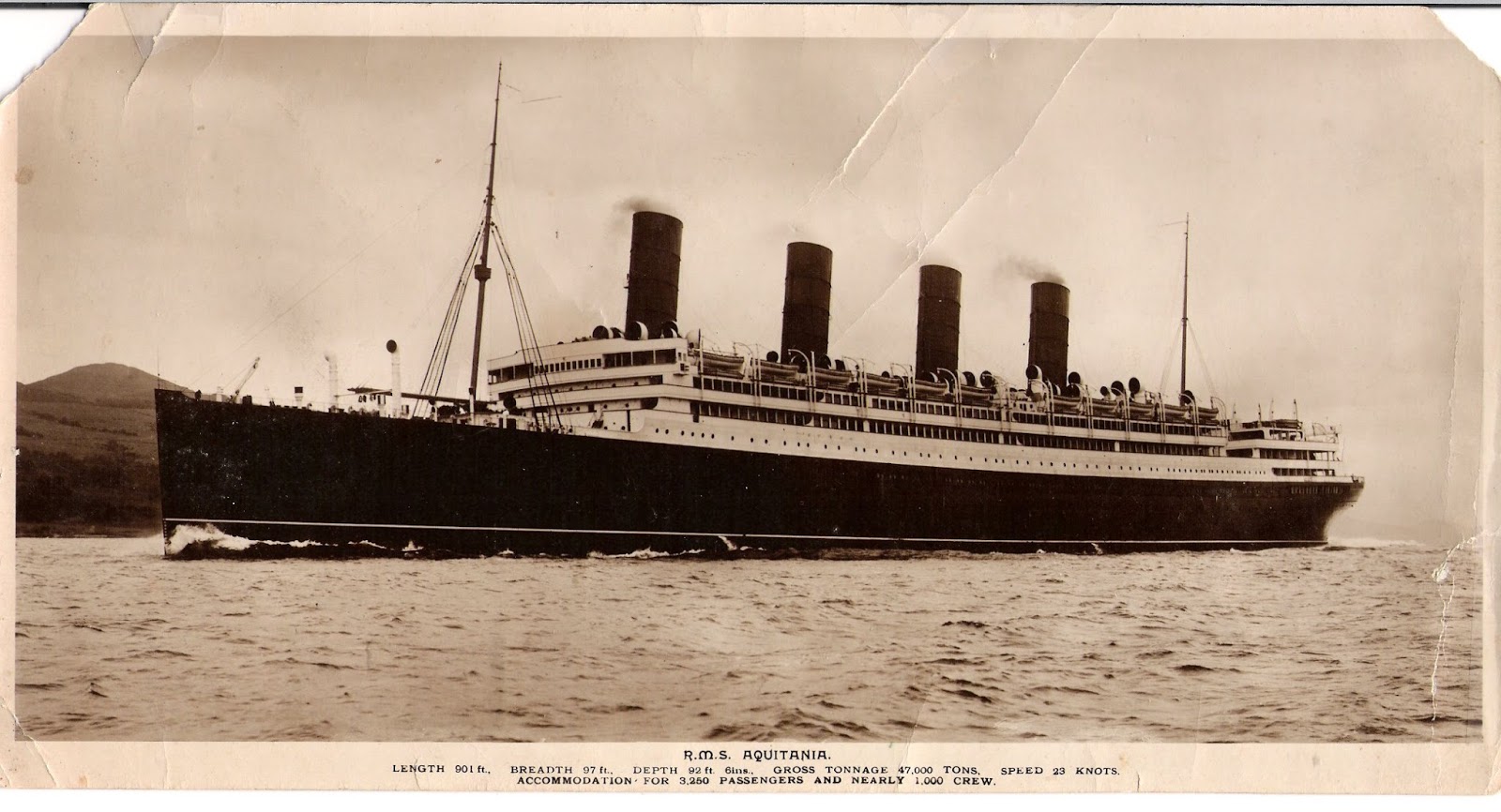
Following World War I, before the dust was settled in certain areas, such as the near East, my folks packed up what to them seemed the necessary belongings and left for Africa. We sailed away from these shores on board the RMS Aquitania out of New York one midnight in June 1920.

RMS Aquitania

The decks of the Aquitania were really roomy. There was something of wonder every place you looked; each stairway led to a new discovery on that magnificent city of the seas. It was like three hotels at least but floating along at considerable speed.

Southampton, England, was our first real stop. That was where our knee-buckled 1918 breeches were labeled "girl garments" by the local boys. We stayed just a day or two and then embarked on the Channel ferry late one evening. When morning dawned we were at the docks in Le Harve, France.

Getting the suitcases off the ferry and to the train station took some doing, but soon we were chugging our way to Paris. I found myself gawking at the sidewalk urinals.

Paris urinals

We didn't stay in Paris long as we had a ship to catch in Marseilles. This ship was old and tired; it's very name eludes me. The name painted on all the usual places was Greek. I will never forget the giant sized cockroaches jumping about among the pots and pans in the kitchen.

Marsailles, France

When we arrived in Egypt, two mules towed the tram car which whisked us along in Cairo. What a city; what a ride! Palm trees were quite new to us. Local people, dressed in flowing robes and turbans, were sitting on the sand by show cases or large trays of dried figs, dates and cakes or coffee. Along some of the streets there were continuous awnings for blocks on end. Men would sit at tables under these awnings and have coffee or play dominos or checkers. Life seemed sort of leisurely.

After leaving Egypt, we sailed to Jaffa, Palestine, and then journeyed to Jerusalem, riding our first narrow-gauge rail train. It was also our first experience with the class system -- first, second and third class coaches. A large crowd gathered to get on the train. There were turbaned gentlemen, veiled ladies, robed Arabs, as well as an assortment of other nationals. Ragged folks, well dressed folks, some ancient and some very young were all eager to be on the train. When it came some people hoisted luggage and friends through windows, they guarded doors to keep out the invasion, saving space for themselves. Conditions were not at all orderly. What a scramble!

Volumes could still be written about Jerusalem that ancient, historical, political, religious, old yet new city. A city destroyed, rebuilt, burned to the ground, resurrected, broken to rubble and still it stands on those memorable hills -- the city of David, the city of Solomon. Oh what a city!

Jerusalem wheat market, 1920

In Jerusalem we engaged a vehicle resembling an old Western stage coach for the run down to the Dead Sea. By the shore we saw a number of excavated squares some two or three feet deep. A small ditch connected each square to the sea. By this method each square was filled with salt water, sealed off, and evaporation left a cake of salt.

Auto on the Dead Sea beach circa 1925. Photo courtesy of ynetnews.com

The present Jericho contains but a few buildings. One of the more outstanding was the Hotel Jericho. The walls are painted white and the roof was made of vivid red tile. Mosquitoes were numerous and we slept under netting for the first time.

We walked many miles the day we went to Nazareth. There was war then. Heavy gun fire could be heard in the distance. Traffic was almost non-existent. A military truck came along and gave us a lift. We were taken across the Sea of Galilee in the commander's motor launch. Due to the general unrest in the area, he urged us to spend the night in his military camp. So we had a tent, camp beds, and all the comforts of home.

Syrian soldiers during the Franco-Syrian War

Our wandering from place to place in the Holy Land was halted by the war action between Galilee and Damascus.(1) We saw many large shells along the roads. The three weeks allocated for our visit to the Middle East seemed all too soon gone. There was so much more to see and a lot we would have to remember.

Next for our family was to return to Port Said and our ship.

This leg of the journey will be continued in a future post.
__________
(1) This was the Franco-Syrian war which took place between the Arab Kingdom of Syria and France in 1920.