I have finally seriously begun to study how to research eastern European ancestors so I can begin to work on Mom's and my husband's sides of my family tree. One morning over coffee I was bemoaning the difficulties I have experienced. Pete agreed it sounded tough and said I should write a blog post about it so others who are thinking of doing the same thing will know about which issues to watch or take into consideration. I'm certainly no expert but am making progress in my education.
According to AncestryDNA eastern Europe includes these countries: Albania (northern), Austria, Belarus, Bosnia and Herzegovina, Croatia, Czech Republic, Estonia, Greece (northern), Hungary, Latvia, Lithuania, Macedonia, Moldova, Poland, Romania, Russia (European), Serbia, Slovakia, Slovenia, Turkey (European), and Ukraine. It's as good a definition as any other I have found.
 |
Map of Eastern European Ethnicity per AncestryDNA; image courtesy of
Ancestry.com |
Regardless of the specific country in which you find your research taking you, most of these countries require knowing certain facts before you can truly begin to make progress. And they are:
1. What calendar was in use?
It sounds crazy, I know, but if you want to add a certain date to an ancestor's timeline that puts that information in context with your other known ancestors, then you will likely want to use the Gregorian Calendar, which is what we use today. The Gregorian calendar was named for Pope Gregory XIII, who introduced it in 1582.
The calendar is sometimes known as the Western or Christian calendar. Not surprisingly, Catholic European countries were first to convert to the new calendar. Protestant and Orthodox countries adopted the Gregorian calendar sometimes centuries later with Greece being the last country to adopt it in 1923.
I use this web
page to determine what calendar the country in which I am researching was using at the time of the ancestor about whom I am working. Then I go to Stephen P. Morse's
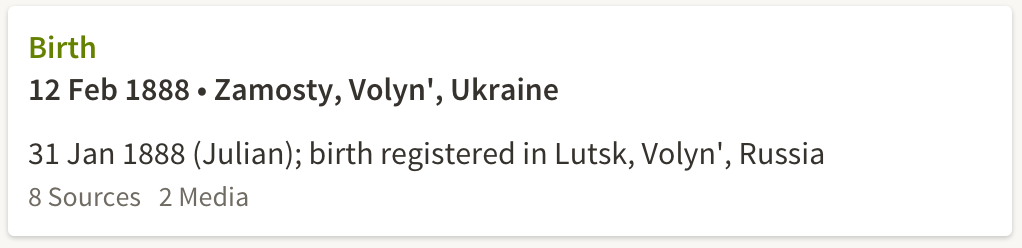
converter to determine what the Gregorian calendar date is for a record created using the Julian calendar. I enter the Gregorian date as the fact in my family tree and add a note in the description field that includes the original Julian calendar date with (Julian) in parenthesis. The recording of the facts about my paternal grandfather Gustav Lange's birth is a good example:
 |
| Gustav Lange birth fact in my family tree; image courtesy of Ancestry.com |
You could use an alternate birth fact, but my personal preference is to keep all of the information together as it really was the same date. If I had a source that listed an entirely different date, then I would use the alternate birth fact to record that information.
2. What religion did your ancestors practice?
Religion was more important in the daily life of our ancestors than it is for many of us today. My maternal grandmother's family moved from what is now Maliniec, Poland, to what is now Ukraine, but was then Russia, primarily for economic reasons. However, Tsar Alexander II offered many inducements, including the freedom to practice a different religion from Russian Orthodoxy, which was the empire's official religion. When Tsar Alexander III came to power, he rescinded those inducements and jailed my grandmother's family's minister. They undertook a 5,000+ mile journey in 1893 to escape Russia in order to practice their German Baptist faith. Many from their community and church made the same journey at the same time and settled in the same area in Canada where they built a church together. Without knowing your ancestor's religion, you will not know in what churches to look for records if none exist at the civil authority.
 |
Photograph of the congregation of the First Baptist Church of Fredericksheim
in Leduc, Canada, which my great grandfather helped build; photograph
courtesy of Lucille Marian (Fillenberg) Effa |
3. In what country did your ancestors reside?
Country boundaries changed a lot over time in Europe, but especially in eastern Europe. Poland actually disppeared from the map in 1795 after the third partition of the country as Prussia, Russia, and Austria gobbled it up. Other countries lost wars and territory and there was a war somewhere in eastern Europe for much of history. It is important to know in what country the town or area in which your ancestor lived at the time your ancestor lived there. It's also important to know the contemporary name of the location in case you want to plot it on the map.
I typically enter the current place name in the location field and the historical name in the description field. I do this so that mapping function of my family tree software will work. If they lived in a very small village that is not recognized by my software, I enter the region and enter the village name in the description field. By knowing the country in which Zamosty was located at the time of Gustav's birth, I can use
Wikipedia or the
JewishGen town search to get the correct spelling or current place name. Because most of my eastern European ancestors lived in Poland and the Volhynia region, I joined the
Society of German Genealogy in Eastern Europe. Members have created some of the best gazetteers I have found. If your ancestors are from other countries in eastern Europe, however, the society's resources will not be as helpful.
4. What was the national language and what language did your ancestors speak?
Once you know the country in which your ancestor resided, then you will likely have a good handle on the official language spoken there. However, be aware that some countries allowed administrative areas to speak different languages based on the majority nationality in the area as did Russia until the reign of Tsar Alexander III. If you are lucky enough to find records about your eastern European ancestors, then knowing the language in which the record was written will be extremely helpful as you will need to have the record translated. I find Facebook groups very helpful for translations, but I must know to which group to post the record.
My maternal grandfather's birth registration provides a great example of how you can get tripped up. Remember, Gustav Lange was born in 1888. His birth information was recorded in German on a form pre-printed in Russian! After 1894, his birth information would have been recorded in Russian due to a change in the law.
 |
| Gustav Lange's original birth certificate; personal collection |
Knowing it was in German enabled me to obtain a translation from the German Genealogy Facebook group. I now understand there is another group specifically for German translations.
I have found it particularly helpful to read the Ancestry.com and FamilySearch.org wikis before I begin researching in a foreign country. I also spend a lot time reading about the history of the country, especially its internal civil procedures and how local governments were organized for administrative purposes.
I hope you found these tips useful. Please let me know if you have others.