Showing posts with label Civil War. Show all posts

Tuesday, January 22, 2019

Nine Sons Wore the Suit of Gray

My three times great grandparents, James Harvey Beard and Mary McMullin (or McMullen) had four known sons:
  • David Fleming Beard, Sr. (1812-1878), my great great grandfather
  • Granville Lacy Beard (1813-after 1873)
  • Robert M Beard (about 1818-after 1880)
  • Charles Edward Beard (1827-1900)
Charles Edward Beard married Ann Elizabeth Key, daughter of John Bernard Key and Paulina Overstreet, on 21 November 1849 in Bedford County, Virginia, and two of his nieces married younger brothers of his wife, Ann.

Beard-Key marriages; created using Microsoft PowerPoint

Apparently the Beard and Key families were quite close as evidenced by the fact that my great great grandparents, David Fleming Beard and Barbara Ann (Mitchell) Beard are buried in the Key Family Cemetery in Bedford County.

According to a book about the Key family, John Bernard Key, was born in Petersburg, Virginia, to Thomas and Nancy Keys. He moved to Bedford County, Virginia, when he was 17 or 18 years old. Also living in the southern part of the county was a family with the same surname. The mail frequently was delivered incorrectly so John Keys dropped the "s" from his surname.

Ann Elizabeth Key, wife of Charles Edward Beard, was one of thirteen children. Nine of her brothers served in the Confederate States Army (CSA):
  • Thomas Henry Key, born 3 September 1821; enlisted in Company C, 28th Virginia Regiment on 10 August 1863; mustered out on 30 March 1864 at a hospital in Richmond, Virginia; according to Find A Grave he died on 30 March 1865 and was interred in Texas so there is some mystery about the end of Thomas' life. 
  • Robert N. Key, born 17 February 1823; enlisted in Company G, 34th Virginia Regiment; died on 10 April 1862 in the Confederate army (according to his brother). His company muster rolls stated that he was "supposed to be dead since April 1862." 
  • Charles Hopkins Key, born 29 November 1825; enlisted in Company G, 34th Virginia Regiment on 3 March 1862; captured on 6 April 1865 in Farmville, Virginia; died in prison in 1865 in Newport News, Virginia. 
  • Yelverton Peterson Key, born 29 October 1829; enlisted in Company G, 34th Virginia Regiment on 3 March 1862; wounded and sent to a hospital in Petersburg, Virginia, on 18 May 1864; died 2 April 1911.
  • Edward Willoughby Key, born 17 January 1835; enlisted in Company G, 34th Virginia Infantry on 3 March 1862; captured on 6 April 1865 in Farmville.
  • John Singleton Key, born 6 May 1839; enlisted in Company G, 34th Virginia Regiment on 1 May 1863; died 4 June 1864 at a hospital in Petersburg.
  • Joseph Cephas Key, born 7 May 1841; enlisted in Company G, 34th Virginia Regiment on 3 March 1862; transferred from a hospital in Farmville to a hospital in Bedford County on 29 March 1865; died 21 January 1884 according to his widow from a lung illness contracted during the war.
  • Benjamin Franklin Key, born 17 January 1844; enlisted in Company G, 34th Virginia Regiment on 3 March 1862; transferred to a hospital in Farmville on 2 April 1865; died 1 May 1925.
  • William Alfred Key, enlisted in Company E, 34th Virginia Infantry in 1864 at Petersburg.
As stated earlier, Thomas Henry Key's death is a bit of a mystery. In Key and Allied Families, written by Mrs. Julian C. Lane, his brother wrote in a letter, "Thomas Henry, b. Sept. 3, 1821, d. in Confederate Army Mar 1865; m. Cecilia A. Owens." Yet, his military records indicated he mustered out of the Army on 30 March 1864. He was interred Pilot Grove Cemetery in Yoakum, Texas, and the inscription on his headstone says, "Thomas Henry Key PVT 2 Co C 28 VA INF Confederate States Army Sept 3 1821, Mar 30 1865." His widow lived in Pike County, Missouri, in 1870 with their children.

Benjamin Franklin Key wrote to a grandson of his brother, Charles Hopkins Key about the experiences of the nine brothers during the Civil War:

"You asked me to tell you something about your grandfather. He belonged to Company E, 34th Virginia Regiment[1], Capt. William Jordan's company, Wise Brigade, Infantry, and was taken prisoner not very long before Gen. Lee's surrender at Appomattox and was kept in prison at Newport News, Va., until June 25, 1865, he passed out and went home to be with his Redeemer. I can say this, that a more devout Christian ever lived or died. He was imprisoned about three months and buried at Newport News. Your papa scarcely remembers ever seeing him. He was born Nov. 29th, 1826. Besides him I had seven other brothers in Civil War, namely: Thomas H., who was born Sept. 3, 1821, and died at a hospital in Richmond, Va., March, 1865. Robert N. was born Feb. 17, 1823, was put on a boat in Yorktown very, very ill with double pneumonia enroute to hospital in Richmond, but never landed, supposed to have died and was thrown overboard. Yelverton P., Edward W., Joseph C., William A., and myself were the only ones to return and I came from a hospital in June at Farmville after the surrender, minus a foot I lost on our retreat the 29th of March, 1865, and John S. Keys was born May 6th, 1839, and died June 4th, 1864, in a hospital in Petersburg."

Benjamin Franklin Key is credited as the author of this verse:

Nine sons wore the suit of gray,
Four sons passed o'er the way --
And their deeds, proud deeds shall remain for us,
And their names, dear names without stain for us,
And the glories they won shall not wane for us,
     In legend and lay
     Our heroes in gray
Though dead, shall live over again for us.

The 34th Virginia Infantry Regiment was formed in May 1862 from men from Norfolk, Richmond, and Yorktown and the counties of Gloucester, Mecklenburg, Bedford, Greene, and King and Queen. For almost two years the unit served as heavy artillery. During that time it was known as the 4th Heavy Artillery and was assigned to the Department of Richmond. In May 1864 it was assigned to Wise's Brigade as an infantry unit. It participated in the Siege of Petersburg and saw action in various conflicts around Appomattox.

_______________
[1] According to muster rolls Charles Hopkins Key served in Company G, not Company E.

Lane, Mrs. Julian C. Key and Allied Families, (Baltimore, MD: Clearfield Co., Inc., 2003), pages 275-280.

Sunday, July 1, 2018

50th Anniversary Commemoration of Gettysburg

Today is the 155th anniversary of the Battle of Gettysburg, considered the most important engagement during the Civil War.

From 29 June and 4 July 1913 a 50th anniversary reunion was held at Gettysburg. There had been numerous smaller reunions previously, but 1913 was the largest ever with over 53,000 men attending from 46 of the then 48 states, including over 8,500 Confederate Army veterans. The reunion was called the Gettysburg Battlefield Encampment. The Chief Surgeon of the U.S. said at the time, "never before in the world's history [sic] so great a number of men so advanced in years been assembled under field conditions." Not only was there concern about the men's health, people were also concerned there might still be lingering "unpleasant differences."

July 2 was Military Day; July 3, Civic/Governor's Day; and July 4 was National Day and included a speech by President Woodrow Wilson in which he said:

"We have found one another again as brothers and comrades in arms, enemies no longer, generous friends rather, our battles long past, the quarrel forgotten -- except that we shall not forget the splendid valor."

Photograph of attendees of the 1913 Gettysburg Battlefield Encampment;
courtesy of the Library of Congress

On 5 May 1913, Powhatan County, Virginia, supervisors said they would defray the cost of any ex-Confederate soldier who wished to attend the fiftieth anniversary celebration of the Battle of Gettysburg. A committee was formed to determine which veterans wished to attend. Thirty-eight veterans from the county attended, including Joseph Sampson Jennings, who had served in the Powhatan Light Artillery Battery during the last year of the war. Powhatan County spent $325,000 to send their veterans to Gettysburg.

When the veterans assembled in 1919 to attend a reunion in Atlanta, only six were able or willing to go.

Tuesday, April 24, 2018

Did These Beard Brothers Die in the Civil War?

As I began researching my great great grandfather, David Fleming Beard, Sr., for the umpteenth time, I realized the fate of two of his sons by his first marriage is clouded in mystery...at least to me.

David was married twice and it is the two sons he had with his first wife, Ann Dooley, I am questioning.


The wives and children of David Fleming Beard, Sr.; created using
Microsoft PowerPoint

Edward M. Beard

David's eldest known child was Edward M. Beard was born about 1843 in Bedford County, Virginia. Edward appeared in the 1850 and 1860 census with his parents and younger siblings. Those are the only records I have collected that I know belong to "my" Edward M. Beard. My questions begin with the Civil War and end with when did Edward die.


Report of Sick and Wounded; courtesy of Fold3.com

I have at least three possibilities for his death date:
  1. A Virginia Deaths and Burials Index, 1853-1917, indicated an E. M. Beard died in 1862 in Bedford County. No approximate birth year or location was included.
  2. A 14-page military file for an E. M. Beard, born in Bedford County, died on 16 June 1863 in Richmond General Hospital No. 20 of typhoid fever. One page of this record indicated his name was Edward M. Beard.
  3. A Bedford County 1901 Chancery Court file indicated an E. M Beard was a plaintiff, along with his sister and her husband, in a case initiated in 1891 when the bill of complaint was filed.
The military service file raises additional questions about why his enlistment date and location changed. Please note the name of the attorney who filed a death claim with the War Department. James F. Johnson well known to Edward's grandfather, James Harvey Beard. He was the executor of his will and James Beard entered into a contractual relationship with Mr. Johnson in order to secure his second wife's financial independence. This is a strong indication that the E. M. Beard who died in 1863 of typhoid fever was the son of David Fleming Beard.

Click image to enlarge.
Analysis of the 14-page military service file for E. M. Beard (click on the
image to enlarge); created using Microsoft Excel

Based on the three conflicting records -- 1862 death index, 1863 military service death, 1901 Chancery court case -- I thought I would find at least three men named E. M. Beard in the 1860 Bedford County census. But I did not. There were 25 men with the surname Beard but other than the Edward M. Beard, who lived with his parents, none of the other 24 look remotely like possibilities for the two men who died in 1862 and 1863.

The bill of complaint filed with the Bedford County Chancery court stipulates the relationship between the parties:

"B. D. Mitchell and Martha V., his wife[1], and E. M. Beard, complainants, respectfully represent that David F. Beard departed this life several years ago, intestate, leaving surviving him his widow. Beard had the following children to wit: Martha V. Mitchell, E. M. Beard, Effie Beard, Berta Beard, and David Beard. The last three of whom are infants[2]. At the time of his death the said David F. Beard was [illegible] and possessed of a tract of land containing 210 acres, mostly mountainous and of little value. The widow and infant children occupied this place until last September when she, the widow, died."

It seems pretty straightforward. E. M. Beard did not die in 1862 or 1863 as he was alive in 1891 when the bill of complaint was filed until you realize that one of David F. Beard's children by his second wife was not mentioned. Albert M. Beard was over 21 years of age at the time the case was initiated and had an interest in the disposition of the land.  Therefore, he should have been named in the case as plaintiff or defendant. Could it be that E. M. Beard was really Albert? If Edward and William died during the Civil War, then the order in which David Beard's child were listed in the bill of complaint was in the correct birth order if E. M. Beard was Albert M. Beard. If Edward M. Beard died in 1862 or 1863, he died unmarried and without issue, meaning he left no heirs who would have an interest in their grandfather's estate.

Albert M. Beard was assigned by the court as administrator of his father's estate in 1891 after his mother died and filed a list of sales of personal property and an administrator's account with the county clerk. 

In 1895 David Fleming Beard, Jr., asked the court to make E. M. Beard his guardian. This could be another sign that E. M. Beard in this case was Albert.

What do you think?

William H. Beard

I do not have source information for William H. Beard's death date and location. Every public tree I have seen contains a death date and location but not a single tree includes any source information. He was born about 1847 so could have joined the Confederate States Army (CSA) in 1864 or 1865.

I have found a W. H. Beard who was conscripted into the CSA on October 16, 1863. The muster card indicated he was 20 years old, making five years older than he actually was. It is possible William lied about his age. This W. H. Beard served in Company C, 6th Battalion (Tredegar's), Virginia Local Defense Troops. In September 1864 the 6th Battalion and the 2nd Infantry Battalion were consolidated. W. H. Beard was assigned to Company F, 2nd Virginia Infantry, Local Defense.

I have a note for William H. Beard, which states he died on 31 May 1865 at Point Lookout Military Prison in Maryland. However, I can find no record of his death and there is no notation of his death in the service record of W. H. Beard, which is unusual. The Saint Mary's County Historical Society began publishing the Chronicles of Saint Mary's in 1953. The publication includes information about the Civil War and the prison. I have contacted the society to learn if they have the definitive information about William's fate.

Last muster roll record for William H. Beard; courtesy
of Fold3.com

So did David Fleming Beard, Sr., lose two sons in the Civil War? One son? No sons? And if not, what happened to Edward M. and William H. Beard after the war? I would very much appreciate readers' thoughts on the next steps for my research to solve this conundrum.

_______________
[1] B. D. Mitchell was Burwell David Mitchell and Martha V., his wife, was Martha Virginia (Beard) Mitchell. Interestingly, Burwell was the older brother of Barbara Ann (Mitchell) Beard, the defendants' mother.
[2] Infants in legal terms of the day meant the children were under 21 years of age.

David Fleming Beard, Sr. (1812-1878): A Man of His Times
The Court Doth Adjudge, Order and Decree

Wednesday, February 21, 2018

Charles Edward Jennings' Civil War Pension Application

At the age of 70 my great grandfather, Charles Edward Jennings, moved from Roanoke, Virginia, to Erwin, Tennessee and lived with his daughter Leta Vernon (Jennings) Womack and her family. Two years previously, in 1911, he had placed his three living children by his second wife with relatives and in an orphanage.

After living in Tennessee for a few years, he applied for a pension from the State of Tennessee for his service in the Confederate States of America (CSA) Army. He would qualify for a pension after providing information about his service, how he got out of the Army, his disability or indigency, and a doctor or a trustee of a county had to provide information about his character. He completed his application on 24 March 1917, five months before he died.

Charles Edward Jennings; courtesy of Janie Darby

Soldier's Application for Pension

I, Charles Edward Jennings, native of the State of Virginia and now a citizen of Tennessee, resident at Erwin, in the County of Unicoi, in the State of Tennessee, and who was a soldier from the State of Virginia, in the war between the United States and the Confederate States, do hereby apply for aid under the Act of the General Assembly of Tennessee, entitled "An Act for the benefit of the indigent and disabled soldiers of the late war between the States, and to fix the fees of attorneys or agents for procuring such pensions and fixing a penalty for violation of the same." And I do solemnly swear that I was a member of Company H, 19th Virginia Infantry, in the service of the Confederate or United States, and that by reason of disability or indigence I am now entitled to receive the benefit of this Act. I further swear that I do not hold any National, State or county office, nor do I receive aid or pension from any other State, or from the United States, and that I am not an inmate of any soldier's home, and that I am unable to earn reasonable support for myself or my family. I do further swear that the answers given to the following questions are true:

In what County, State, and year were you born? Amherst Co., Va. 1843

When did you enlist and in what command? Give the names of the regimental and company officers under whom you served? March 1, 1862. J. T. Ellis, Captain Taylor Berry and Ben Brown, Captain. Col. Struggs, Regimental Commander.

In what battles were you engaged, and, if not wounded, state what disabilities did you receive, if any? Williamsburg and Seven Pines.

What was the precise nature of your wound or disability, if any? X

Were you incapacitated from service by reason of said wound or disability incurred? X

Were you discharged from the army by reason of said wound or disability? X

If discharged from the army, where were you and what did you do until the close of the war? X

What was the name of the surgeon who attended you? X

How did you get out of the Army, when and where? Appomattox, at end of war.

Were you ever in prison? If so, state what prison and when released? No.

Were you paroled? If so, when and where? No.

Did you take an oath of allegiance to the United States Government? No.

If so, when and under what circumstances? X

Have you applied for a pension before this? If so, about when? No.

Are you married or have you been married? Widower.

If so, what is the size of your family living together? None.

What are the respective ages of your wife and the children living with you? None living with me, but support one 15-year-old.[1]

To what sex do your children belong? Both, 5 males and 3 females.

In what business are you now engaged, if any, and what do your earn? None.

What estate do you have in your own right, real and personal, and what is its actual cash value? Real estate about $2,500.

What estate has your wife in her own right, real and personal, and what is its actual cash value? X

State the gross income of you and your wife from all sources for the past year. This must included all money received either from wages, rents or interest on loaned money, if any. Also family supplies raised or received from rents and used by your family. $432.

How have you derived support for yourself and your family for the past five years? Rent from property.

How long and since when have you been an actual resident of Tennessee? About three years, since Dec. 1913.

Have you an attorney to look after this application? No.

Give his name and address? C. E. Jennings, Erwin, Tenn.

Witness my hand this 24 day of March 1917.

WITNESSES

W. T. Woodward
Erwin, Tennessee

T. C. Payne
Clifford, Virginia

E. B. McGinnis
Amherst, Virginia

24 March 1917 doctor's assessment of the health of Charles Edward Jennings;
courtesy of Tennessee State Library and Archives

The trustee of Unicoi County certified that Charles Edward Jennings had no property and W. S. Erwin, clerk of the county, certified that the answers provided on the application were true on 24 March 1917. His doctor appeared before a notary public and provided an assessment of Charles' health:

Bronchial asthma, rheumatism, and valvular lesion of the heart. This man is entirely or totally incapacitated from performing any manual labor whatever. As a result of his heart lesion, he has swollen feet, tires easily, has shortness of breath on exertion, etc. This man needs an attendant most of the time.

W. H. Carter, clerk of the Unicoi County Circuit Court, certified that E. B. McGinnis and T. C. Payne were good, upstanding citizens of the community and personally appeared before him to witness Charles' application and verify it was truthful. They also swore he had good habits and was "free from dishonor." E. B. McGinnis also swore he served with Charles Co. H, 19th Virginia Infantry for three years and he was a "true and loyal soldier."

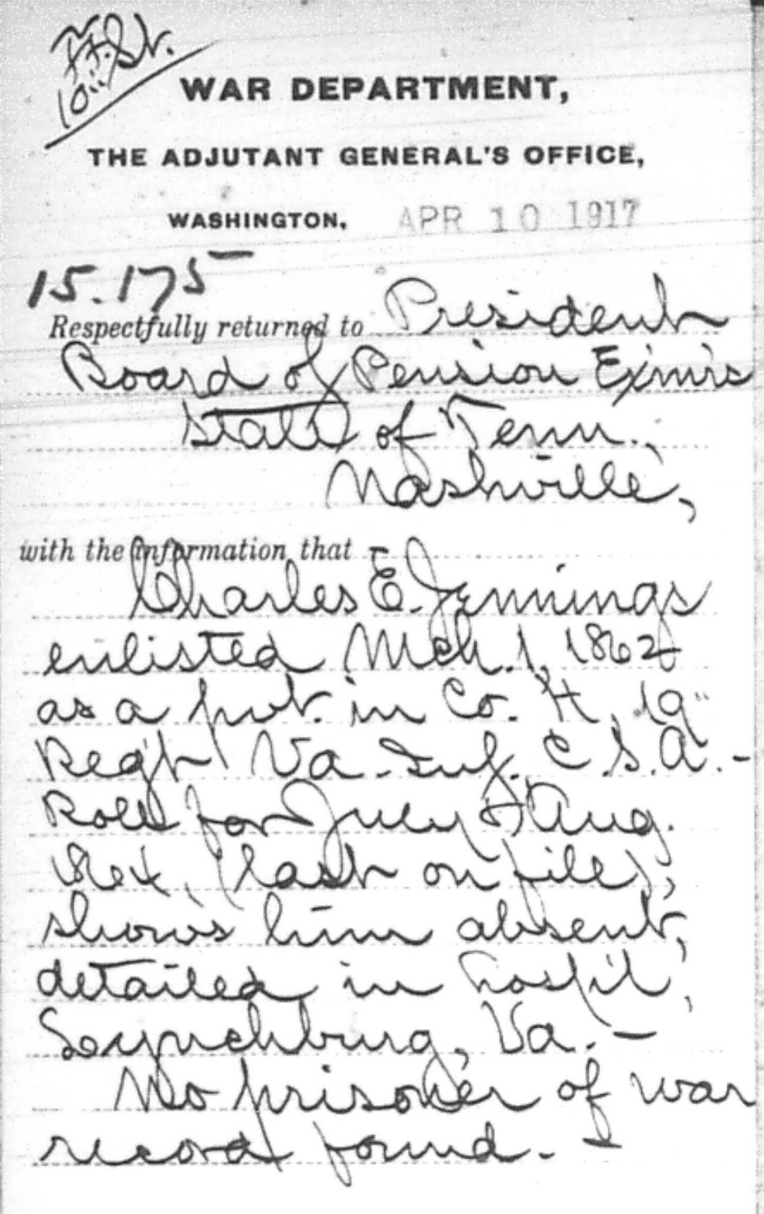
10 Apr 1917 response from the War Department;
courtesy of Tennessee State Library and Archives

The Board of Examiners queried the War Department on 7 April 1917 regarding the service particulars of Charles Edward Jennings. The War Department responded on 10 April with the following information:

Charles E. Jennings enlisted 1 Mar 1862 as a pvt. in Co. H, 19th Regt. Va. Inf., C.S.A. Roll for July, Aug. 1864, last on file, shows him absent, detailed in hospital Lynchburg, Va. No prisoner of war record found.

15 Jun 1917 letter to Charles Edward Jennings in response to
his pension application; courtesy of Tennessee State Library
and Archives

On 15 June 1917, two months before Charles died, the Tennessee Board of Pension Examiners, wrote to him:

Mr. C. E. Jennings
Erwin, Tennessee

Dear Sir:

In examining your application for pension, the last record I can find of you reports your "absent, detailed in hospital at Lynchburg, Va." It will be necessary for you to prove that you remained in service until the close of the war by someone who was with you, and who can speak from personal knowledge."

In reply, Charles had W. D. McDaniel certify before a notary public that he served with Charles in Company H, 19th Virginia Infantry until the close of the war.

It did little good. Charles Edward Jennings' pension application was rejected by the State of Tennessee.

The War Department was correct. He was detailed to work in a hospital in Lynchburg per a surgeon's certificate due to curvature of the spine. A board of medical examiners declared him fit to return to his regiment on 21 October 1864 and there his service records ended. So I am left with the same question I had after finding his military records, did Charles return to his unit, which was captured en masse at Saylor's Creek on 6 April 1865? Or did he simply go home to Amherst County?

I also have some new questions. Why did he not state on his application he had been detailed by special order[2] to serve in hospitals in Lynchburg? And how did he find witnesses who swore he served with the regiment during the entire course of the war when he obviously did not.

________________
[1] The 15-year-old child was my grandfather, Marvin Edward Jennings, Sr., who was placed in an orphanage in Salem, Virginia. His father paid a fee for his care.
[2] The special order was signed by Gen. Robert E. Lee and commanding the following on 18 May 1863: "Private Chas. E. Jennings of Co. H, 19th Virginia detailed for duty in Genl. Hosptl. at Lynchburg, Va. and will report to Sargt. W. O. Owen in charge for assignment."

Friday, February 16, 2018

52 Ancestors #7: Charles Edward Jennings: Veteran of the 19th Virginia Regiment

Ancestor Name: Charles Edward Jennings (1843-1917), great grandfather
DNA Haplogroup: I-M253

Continued from Charles Edward Jennings (1843-1917): First to Leave the Farm

I wrote extensively about the Civil War history of the 19th Virginia regiment as so many of my Jennings ancestors served in that regiment. The links are in listed in the sources at the bottom of this post.

During the winter of 1861 the 19th Virginia Regiment had been assigned to Brigadier General George Pickett. The brigade was part Second Division commanded by Major General James Longstreet. On 7 March 1862 the men of the 19th received orders to "cook three days" rations. After a long march from their winter camp near the scene of the first Battle of Bull Run, the regiment arrived at the Orange County courthouse. There must have been a reunion among brothers and cousins as new recruit Charles Edward Jennings joined his elder brother John Thomas and two first cousins, Leroy and Daniel Jennings.

Charles had enlisted at the courthouse in Amherst County and was ordered to the assembly point for the 19th regiment at the Orange County courthouse before the veterans of the regiment marched south from their winter camp. The entire unit drilled for two weeks. Soon they received orders to march to Richmond, where they boarded three schooners and sailed down the James River to King's Mill Wharf near Williamsburg. The peninsula was wet and sloppy and men fell prey to disease, and suffering sore legs, swollen feet and aching backs.

I imagine the soldiers stopped thinking about personal discomfort and disease when they were attacked by the Union army of General George McClellan on 26 April near Yorktown. Union forces were trying to capture Richmond, the Confederate capital, by sending ships up the James River and troops along its banks. One of those ships was the USS Galena, an ironclad, had been launched in Connecticut on Valentine's Day. The battle for Yorktown became an artillery duel and the Confederates were outclassed by the Union's 13-inch seacoast mortars. During the night of 3 May, Longstreet's division retreated towards Williamsburg. Companies H and I as well as the 28th Virginia regiment covered the retreat. The next afternoon, the 19th Virginia camped near the College of William & Mary.

Union artillery and their 13-inch "sea monsters;" photograph by James F. Gibson
and held by the Library of Congress

The Union army caught up with the Confederates the next day. General Johnston ordered his army to deploy with Pickett's brigade along the right side of his line. His orders were to turn the enemy's left flank. This was the first large engagement of what became known as the Peninsula Campaign. Pickett's counterattacks along the enemy's left flank were almost successful until Union troops reinforced the line. The Union army was able to destabilize the Confederate's left flank but were unable to exploit this advantage. The Confederates were able to withdraw again during the night.

As the Confederate army retreated up the peninsula towards Richmond, Longstreet's division followed the Chickahominy River. They moved mostly at night and progress was slow due to rain-soaked roads with forced soldiers into swamps. They arrived several miles from Richmond on 17 May and camped along the James River where they stayed until receiving orders to cook three days' rations and prepare to march. The Battle of Seven Pines began on 31 May 1862.

The Confederate objective was to overwhelm the Union corps that were isolated south of the Chickahominy River. Neither side made much headway and generals continued feeding soldiers into the battle. Little was achieved though both sides claimed victory. Up to that time it was the largest battle in the Eastern theater. General Pickett's brigade of which the 19th Virginia was a part bore the brunt of the attack.

The 19th was stationed along the Confederate army's left flank when a contingent of Union troops appeared. The officer wanted to know what soldiers he had encountered. The 19th responded with a fierce, "Virginians!" and promptly began to attack. The fight did not last long but the regiment suffered 20 percent casualties. Pickett withdrew his men about 1:00 p.m. The four Jennings men, including Charles, were unwounded and ready to fight another day.

The Seven Days Battles were a series of six engagements over seven days from 25 June until 1 July 1862, ending with Confederate forces driving Union soldiers back down the peninsula from where they came. These battles marked the end of the Peninsula Campaign, a defeat for the Union Army. General Robert E. Lee had taken over the Army of Northern Virginia a month before, relieving General Johnston, who had been wounded.

The 19th was camped two miles northeast of Richmond on the Mechanicsville Turnpike where the Seven Days Battles began. A small battle at Oak Grove that day was a tactical victory for the Union. They gained ground and were several hundred yards closer to Richmond, but lost over 1,000 men. The next day at Beaver Dam Creek, near Mechanicsville, the Union again won a tactical victory. However, their general severely overestimated the number of Confederate forces he was facing and began withdrawing his army to the southeast, away from Richmond. McClellan never again gained the initiative.

Mechanicsville Turnpike Bridge where more than half Lee's Army crossed the
Chickahominy River on 26 June 1862; courtesy National Park Service

The 19th Regiment marched to Mechanicsville the day of the battle and could hear it in the distance. They were supposed to support General A. P. Hill's division which was engaged with the enemy. However, due to delays they were unable to do so and camped that night near Mechanicsville under arms.

On the morning of 27 June the men of the 19th spent some time repairing bridges at the scene of the Beaver Dam Creek battle. Before noon, however, they were at Gaines' Mill where they found Union forces strongly entrenched.

General A. P. Hill was supposed to be positioned in the center of the Union line with Jackson in support to his left and Longstreet's division to his right (south). However, Jackson's division were late arriving so Longstreet was ordered to create a diversion. Pickett's brigade, including the 19th Virginia, attempted a frontal assault over a hill and down into a ravine but were beaten back under heavy fire, taking significant losses. It was at this time that two of Charles' cousins, Daniel and Leroy Jennings, were wounded.

After Jackson's men arrived, the battle commenced in earnest and the Union army was forced back across the Chickahominy River. It was the only true tactical victory for the Confederate forces of the entire Peninsula Campaign. McClellan began a general retreat south towards the James River during the night of 27 June. Lee ordered Longstreet to pursue the enemy.

The battle of Frayser's Farm, or Glendale, began by accident when Longstreet mistook enemy artillery fire for a prearranged signal. As a result his division and that of A. P. Hill began an unsupported attack against the retreating Union army. The 19th Regiment was commanded by Colonel Hunton as their previous commanding officer had been wounded at Gaines' Mill. They charged the enemy over broken ground and marsh. As they entered an area of woods, they encountered an enemy brigade in full retreat, forcing its way among their ranks. They reformed and turned slightly left to avoid artillery fire. As they advanced they captured an enemy artillery battery, which they turned on the retreating Union forces. At nightfall the battle of Frayser's Farm ended.

There was another battle at Malvern Hill the next day but the 19th Regiment did not take part. They had lost 21 men killed, 115 wounded and one missing during the battles at Gaines' Mill and Frayser's Farm.

For the next six weeks the regiment camped near Richmond, resting and receiving new recruits. Charles became ill and left the regiment and was at home during July and August 1862. His Army records are silent about his whereabouts until 13 May 1863. (My assumption is he rejoined his regiment sometime before it returned to Richmond after fighting at Suffolk.) On 13 May he appeared on the register of the Receiving and Wayside Hospital, or General Hospital No. 9, in Richmond. The hospital was also called Seabrook's Hospital and had been a warehouse before the war. It functioned as a receiving hospital for incoming wounded due to its being located near the Virginia Central Railroad Depot.

General Hospital No. 9, Richmond, Virginia; photograph taken shortly after
the war and courtesy of Civil War Richmond

Two days later, Charles Jennings was admitted to Chimborazo Hospital, which was an extremely large facility constructed in Richmond at the outbreak of the war. He complained of dropsy, which was an abnormal accumulation of fluid beneath the skin or body cavities. He was transferred on 18 May 1863 to the Confederate hospital in Danville, Virginia, he complained of debilitas, a general weakness, lameness, or infirmity.

Chimborazo Hospital, Richmond, Virginia; photograph by Levy & Cohen, 1865

Charles was the subject of Special Order 134 issued by General Lee on 18 May 1863: "Private Chas. E. Jennings of Co. H, 19th Virginia detailed for duty in Genl. Hosptl. at Lynchburg Va. and will report to Sargt. W. O. Owen in charge for assignment."

On 29 May 1863 he returned to the 19th Regiment where I assumed he learned he had been detailed to work in Lynchburg. On 10 Jun 1863 he was attached to General Hospital in Lynchburg.

Lynchburg sat at the intersection of two railway lines. As a result several Confederate hospitals were located in the city. In May and June of 1864 the hospitals were filled with 10,000 patients. Hospitals were organized differently than today. They consisted of several buildings in a complex, each with their own staffs of doctors, surgeons, nurses, cooks, stewards and guards. Throughout the war, the city assigned different purposes and specialties to the buildings, such as surgery, general care, convalescence or quarantine.

Assisting the doctors and surgeons would be male nurses, primarily convalescent or invalid soldiers, female nurses, primarily volunteers and maybe a couple of Sisters from religious orders. Orderlies helped nurses at civil war era hospitals. It is likely Charles either served as an orderly or nurse.

Private Charles Jennings returned to the 19th Virginia regiment in March 1864. The men were in winter camp and the month of March brought extreme hunger. The men lived on cornmeal and later cats, which were skinned, boiled and then roasted. Their taste was compared to rabbits. Charles likely had enough. On 31 March he was examined by the regiment's surgeon, James D. Galt:

"Private C. E. Jennings having applied for a certificate upon which to ground an application for detail to light duty. I certify that I have carefully examined this private and found him incapable of performing infantry duty on account of curvature of the spine which seriously impairs his activity and capacity for labor. I further recommend that he be detailed as a nurse in a military hospital at Lynchburg because in my opinion he is competent to perform such duty."

Letter from 19th Virginia Regimental Surgeon recommending
Private Charles E. Jennings be detailed to a hospital and
placed on light duty; courtesy of Fold3.com

So Charles went back to Lynchburg where he was assigned to work in Pratt Hospital. On 21 October 1864 a Board of Medical Examiners declared him fit for duty and ordered him to return to his regiment. And there his Civil War records end.

Perhaps he simply went home instead. If he did return to his regiment, the brigade to which it was assigned was ordered to Hatcher's Run on 31 March 1865. Elements of the Union army had been sent near there to destroy as many Confederate supply wagons as they could find. Confederate soldiers attacked but were repulsed and the 19th retired from the field.

They joined the slow retreat to Appomattox in a hungry, tired and weak condition without sufficient rations. On 6 April 1865 they stopped to rest on a hill overlooking Sailor's Creek near Farmville. They made fires and were preparing to eat what little food remained when they were quickly surround by the forces of General George Armstrong Custer. The 29 men remaining in the 19th Virginia regiment surrendered. Most were sent to Point Lookout prison in Maryland and remained there until after the war when they were paroled after taking an oath of allegiance.

This is my entry for Amy Johnson Crow's 52 Ancestors in 52 Weeks. The theme for this week was "Valentine." I couldn't in good conscience contrive a connection between the theme and the bloody war history of my great grandfather.

Using the Ancestral Reference Numbering System, Charles Edward Jennings is Ancestor number 8 on my family tree:

8.0 Charles Edward Jennings, son of Powhatan Perrow Jennings and Catherine Jewell, born 23 September 1843 in Amherst County, Virginia; died 10 August 1917 in Erwin, Tennessee; married 1) Nancy "Nannie" Jane Johnson, daughter of William Marshall Johnson and Martha Ann Jennings and 2) Effie Beard, daughter of David Fleming Beard, Sr., and Barbara Ann Mitchell.

Children of Charles Edward Jennings and first wife, Nannie Johnson:

8.1 William Powhatan Jennings born 28 May 1875 in Amherst County; died 2 November 1899.

8.2 Daniel Melvin Jennings born 15 September 1877 in Amherst County; died 23 August 1940; married Myrtle Patti Fitzgerald, daughter of David Crawley Fitzgerald and Pattie Ferguson, on 16 June 1909 in Roanoke.

8.3 Charles Albert Jennings born 27 June 1879 in Amherst County; died 28 April 1947 in Bedford County, Virginia; married Margaret "Maggie" Susan Pifer, daughter of James Edward Pifer and Margaret Loop before 1901.

8.4 Viola "Ola" Jennings born 5 December 1881 in Amherst County; died 15 March 1959 in Roanoke, Virginia; married James Solomon Raike, son of William Jasper Raike and Martha Ann Powell, between 1900 and 1902.

8.5 Leta Vernon Jennings born 5 March 1884 in Amherst County; died 15 October 1958 in Alexandria, Virginia; married Edmund Lenwood Womack, son of Jesse Womack and Elizabeth Pedigo, on 15 September 1906 in Roanoke.

8.6 Harry Lee Jennings born 29 June 1886 in Amherst County; died 22 October 1945 in San Francisco; married Nancy "Nannie" Gay Clayton, daughter of Walker W. Clayton and Josephine Mary Taylor, between 1910 and 1913.

8.7 Johnson Jennings born 11 April 1892 in Amherst County; died 9 August 1892 in Amherst County.

9.0 Effie Beard born 1 October 1871 in Bedford County, Virginia, daughter of David Fleming Beard, Sr., and his second wife, Barbara Ann Mitchell; died 4 May 1906 in Roanoke, Virginia; married 1895 to Charles Edward Jennings. 

Children of Charles Edward Jennings and second wife, Effie Beard:

8.8 Daisy Birdelle Jennings born 14 November 1896 in Roanoke, Virginia; died 28 April 1947 in Statesville, North Carolina; married William Luckey Moore, son of Jay Luckey Moore and Jane Elizabeth Steele, on 20 September 1916 in Johnson City, Tennessee.

8.9 Leo James Jennings born 31 October 1898 in Roanoke, Virginia; died 3 October 1973 in Pacific Palisades, California; married 1) Bonnie Sue Wolfe, daughter of James H. and Mollie Wolfe, on 27 November 1919 in Iredell County, North Carolina, (divorced), 2) Kathleen O'Gorman, daughter of William and Margaret O'Gorman, on 14 March 1933 in Yuma County, Arizona,  (divorced), and 3) Marcella G. (maiden name unknown).

4.0 Marvin Edward Jennings born 16 November 1901 in Roanoke, Virginia; died 1 May 1961 in Arlington County, Virginia; married Alice Muir, daughter of Robert Muir and Ida Mae Riggin on 13 May 1924 in East St. Louis, Illinois.

8.10 Clyde Graham Jennings born 29 December 1905; died 12 June 1906.

_______________
19th Virginia Infantry: After the War, Tangled Roots and Trees (accessed 29 Jan 2018).
19th Virginia Infantry: Battle of Second Manassas, Tangled Roots and Trees (accessed 29 Jan 2018).
19th Virginia Infantry: Battles of South Mountain and Sharpsburg, Tangled Roots and Trees (accessed 29 Jan 2018).
19th Virginia Infantry: Defending Richmond, Tangled Roots and Trees (accessed 29 Jan 2018).
19th Virginia Infantry: First Blood at Manassas, Tangled Roots and Trees (accessed 29 Jan 2018).
19th Virginia Infantry: First Winter Camp, Tangled Roots and Trees (accessed 29 Jan 2018).
19th Virginia Infantry: Fredericksburg and North Carolina, Tangled Roots and Trees  (accessed 29 Jan 2018).
19th Virginia Infantry: Gettysburg and Pickett's Charge, Tangled Roots and Trees (accessed 29 Jan 2018).
19th Virginia Infantry: Peninsula Campaign, Tangled Roots and Trees (accessed 29 Jan 2018).
19th Virginia Infantry: Seven Days Battles, Tangled Roots and Trees (accessed 29 Jan 2018).
A Lover Not a Fighter, Tangled Roots and Trees (accessed 29 Jan 2018).
Battle of Seven Pines, Tangled Roots and Trees (access 29 Jan 2018).
Compiled Service Records of Confederate Soldiers Who Served in Organizations From the State of Virginia, database and images, Fold3, Jennings, Charles E, Co. H, 19th Virginia Infantry, Private, 27 pages (accessed 16 Feb 2014).
Index to Compiled Service Records of Confederate Soldiers Who Served in Organizations From the State of Virginia, database and images, Fold3, Jennings, Charles E., Co. H, 19th Virginia Infantry, Private, Fold3 Job: 13-020 (accessed 16 Feb 2014).
Jordan, Ervin, L. 19th Virginia Infantry, (Lynchburg, VA: H. E. Howard, Inc., 1987) .
Lynchburg served as the site of many Civil War hospitals, News & Advance, The (accessed 2 Feb 2018).
Mapping the 19th Virginia Infantry Regiment: 1861, Tangled Roots and Trees (accessed 2 Feb 2018).
Mapping the 19th Virginia Infantry Regiment: August-September 1862, Tangled Roots and Trees (accessed 2 Feb 2018).
Mapping the 19th Virginia Infantry Regiment: Jan-Aug 1862, Tangled Roots and Trees (accessed 2 Feb 2018).
Mapping the 19th Virginia Infantry Regiment: June 1863-April 1865, Tangled Roots and Trees (accessed 2 Feb 2018).
Mapping the 19th Virginia Infantry Regiment: September 1862-May 1863, Tangled Roots and Trees (accessed 2 Feb 2018).
Meet the Hospital Steward, National Museum of Civil War Medicine (accessed 2 Feb 2018)
Tennessee, Civil War Confederate Pension Application Index, database, Ancestry, Charles E. Jennings, 19th Virginia Infantry, Application No. S15175 (accessed 4 Dec 2014).
Pierce Street Historic District National Register of Historic Places Application Form, National Park Service (accessed 2 Jan 2018).
Powhatan Perrow Jennings (1812-1858): A Life Cut Short, Tangled Roots and Trees (accessed 2 Feb 2018).
The First KIA of the Civil War, Tangled Roots and Trees (accessed 29 Jan 2018).
US Civil War Soldiers Index, 1861-1865, database, FamilySearch, Charles E. Jennings, Private, Company H, 19th Regiment, Virginia Infantry, Confederate; citing NARA microfilm publication M382 (Washington, D.C.: National Archives and Records administration), roll 29; FHL microfilm 881423 (accessed 4 Dec 2014).

Morgan's Rifle Corps Established and the Fog of War
Charles Edward Jennings (1843-1917): First to Leave the Farm
Powhatan Perrow Jennings (1812-1858): A Life Cut Short
John W. Jennings (1776-1858): War of 1812 Veteran
Benjamin Jennings (c1740-1815): Last Will and Testament
Benjamin Jennings (c1740-1815): Morgan's Riflemen
Benjamin Jennings (c1740-1815): Beginnings and Endings
Who Was the Original Jennings Immigrant?
Did John W. Jennings, Sr. (c1777-1858) Marry His Niece?
Discovering my Local History Center
British Surrender at Saratoga
The Great Jennens Case

Thursday, July 6, 2017

Falls Church, Virginia: Occupied by the Enemy

Last summer I went to the historic Episcopal church in Falls Church, Virginia, to photograph the New York memorial stone for the Honor Roll Project, managed by Heather Wilkinson Rojo, author of Nutfield Genealogy.  I was also curious to learn why Union soldiers from New York were buried in a cemetery in Virginia, which was part of the Confederate States of America during the Civil War. I discovered Falls Church was occupied for most of the war by Union troops and its citizens lived under difficult conditions.

Falls Church was occupied by the U.S. 2nd Cavalry on 19 June 1861. A few days later Thaddeus Lowe brought a balloon to Taylor's Tavern and made three ascents to monitor rebel army movements around Fairfax Courthouse. In mid July 35,000 union troops marched through Falls Church on their way to the first Battle of Bull Run (Battle of Manassas if you are from the South), where the federal troops were routed, retreating back to Arlington Heights. After the battle, they patrolled and picketed around Falls Church.

In late August and early September Confederate officers Longstreet and Stuart occupied Munson's Hill (about three miles southeast of Falls Church) and Falls Church. It is believed Longstreet established his headquarters in the town. There were daily battles between the enemy forces in the peach orchards on the eastern slope of Munson's Hill. Thaddeus Lowe ascended from Ball's cross roads (present day Ballston) with union soldiers, who directed artillery fire using signal flags from the air.

Munson's Hill; drawing courtesy of Wikipedia

As September turned in October, rebel troops left the area for their winter camp near Centreville and federal troops re-occupied Falls Church. During the winter of 1861-82, union troops and engineers built several forts -- Buffalo, Munson, Ramsay, and Taylor -- on the hills in and around the town. Entrenchments were also built facing the south and west of Falls Church.

On 20 November 1861, Gen. McClellan held a "grand review," which was attended by President Lincoln near Falls Church. After the event, Mrs. Julia Ward Howe was so stirred with emotion she wrote the words we now sing for the Battle Hymn of the Republic.[1]

The Union Army and home guard occupied Falls Church for the remainder of the war. The Old Episcopal Church, which was built in 1769 was used during one period as a stable. However, I think perhaps it was used as hospital directly after the First Battle of Bull Run as Manassas and Falls Church were connected by railroads. That may be why the 23 men from New York units are buried in the church cemetery. Most of the men served with the 20th New York State Militia, which only served for three months at the beginning of the Civil War.

The church now known as the Old Episcopal Church during the Civil War;
photograph courtesy of the Library of Congress

The Old Episcopal Church in 2016; personal collection

_______________
[1] The music is from John Brown's Body, originally known as John Brown's Song, a marching song about abolitionist John Brown and popular with Union troops during the Civil War.

Honor Roll: Falls Church, Virginia, New York Memorial Stone
Honor Roll Project

Wednesday, August 31, 2016

History Everywhere! Finding a Confederate Spy

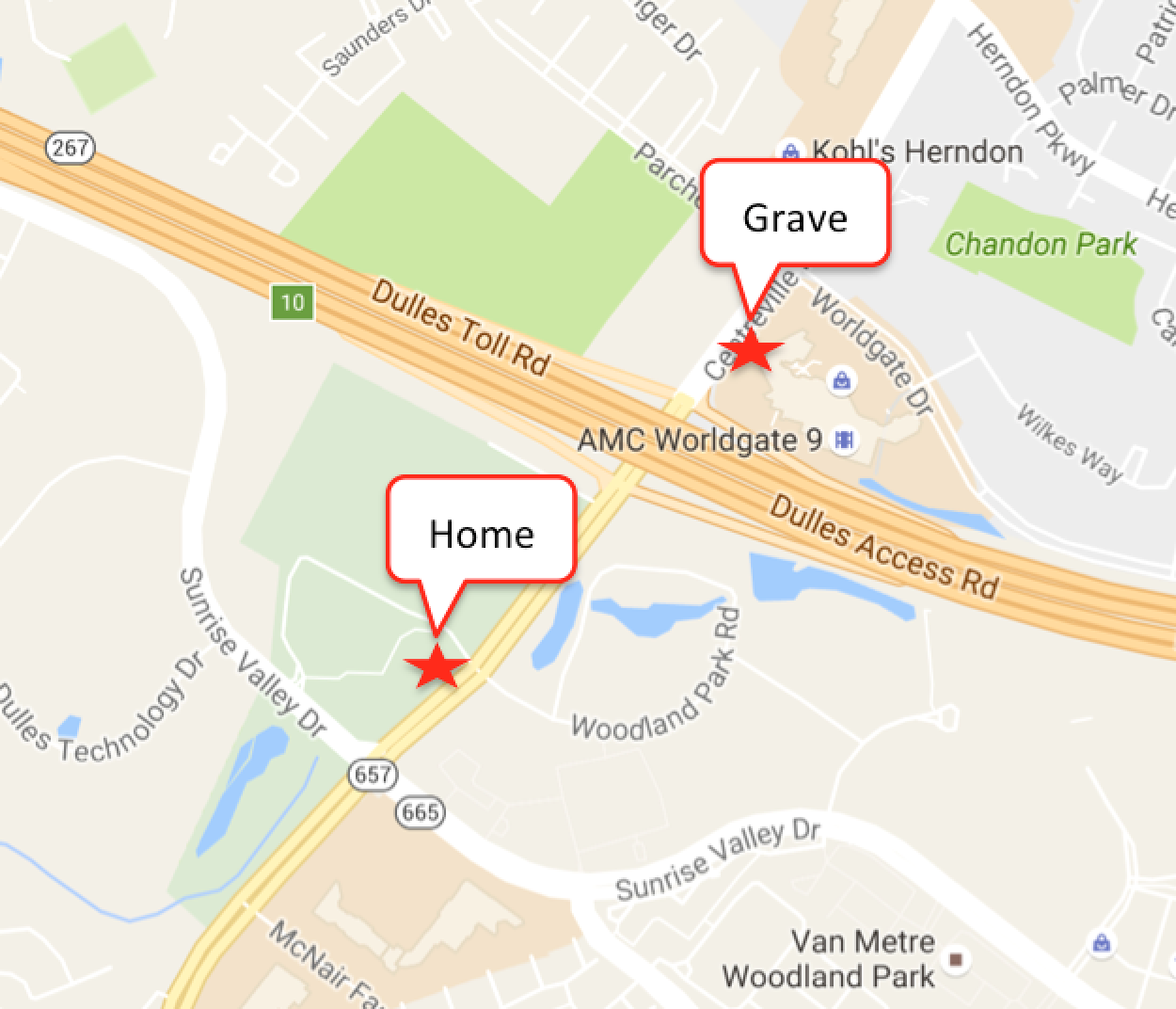
I recently had to get an oversized document scanned. So I went to the closest copy center which had a scanner big enough, which was in the Worldgate Centre, a shopping, office and hotel plaza in Herndon, Virginia. As I was leaving I remembered the grave of a famous Confederate spy was supposed to be somewhere on the grounds of the plaza.

And sure enough, just across the parking lot from the hotel entrance I spotted a historical marker and small fenced graveyard in the middle of a grove of large holly trees.

Laura Ratcliffe historical marker at Worldgate Centre, Herndon, Virginia;
personal collection
Grave of Laura Ratcliffe; personal collection

Laura Ratcliffe was known as a local beauty. Among her many admirers was J.E.B. Stuart, a Confederate States Army officer during the Civil War.

Laura Ratcliffe; courtesy of the Stuart-Mosby Historical Society

Laura was born on 28 May 1836 in Fairfax City, Virginia, to Frances Fitzhugh Ratcliffe and Amy McCarty Lee. She was a 6th cousin of General Robert E. Lee. After her father died, her mother and two sisters moved to Frying Pan (which is now part of the Town of Herndon).

Merrybrook, home of Laura Ratcliffe during the Civil War. The home is one
the grounds of Arrowbrook Park but is privately owned and currently occupied;
personal collection

Laura met James Ewell Brown (JEB) Stuart when she and her sister were nurses in at his winter camp in 1861. She is also said to have saved the live of Colonel John Singleton Mosby, leader of Mosby Rangers and known as the Gray Ghost. He stayed at the Ratcliffe home whenever he was in the area.

Mosby Rangers fought a guerrilla war with small detachments attacking the enemy behind their lines and then disappearing into the country side. They also disrupted communications and transportation. Laura would learn about Union military activity in her area and leave Mosby messages under a rock on Squirrel Hill, a part of the Ratcliffe's property. She saved his life when she communicated to him that the Union Army were planning on setting a trap for him near her home. A Union Army officer described her as a "as a very active and cunning rebel, who is known to our men, and is at least suspected of assisting Mosby not a little in his movements."

After the war Laura married a Union veteran, Milton Hanna. During her lifetime, Laura never received recognition for her role as a Confederate spy. She died on 8 August 1923 at Merrybrook, her home (photo above). Among her personal effects an album of poems was found. There was an inscription which was signed by JEB Stuart and several of his officers, which read:

"Presented to Miss Laura Ratcliffe by her soldier-friend as a token of his high appreciation of her patriotism, admiration of her virtues, and pledge of his lasting esteem."

Map of the Centerville Road-Dulles Access/Toll Road interchange in Herndon,
Virginia; Google maps modified using Microsoft Powerpoint

_______________
Civil War Guerrilla Partisans: Mosby's Rangers

Friday, April 1, 2016

Civil War Guerrilla Partisans: Mosby's Rangers

Perhaps one of the most famous Confederate commanders was the Gray Ghost as John Singleton Mosby was known. Mosby was the commander of the 43rd Battalion Virginia Cavalry. They were partisan rangers and not a typical unit of the Confederate Army of Northern Virginia. Mosby's rangers conducted hit-and-run raids on the rear of the Union armies in northern Virginia; then melted into the surrounding countryside. Detachments were scattered throughout the region and were a persistent, nagging threat to Union soldiers. Many of the battalion's actions went unrecorded. The most fruitful way to research the Gray Ghost's troops, is to read the unit histories of Union regiments that served in Virginia.

My first cousin three times removed, Matthew Wilson Jennings enlisted in Company F on 17 September 1864 for the duration of the war. The company elected Walter Frankland captain. He had been with Mosby since February 1863 and was the battalion's quartermaster. Soon after the company completed its organization, Mosby sent them to scout the Shenandoah Valley with Brigadier General William Chapman, commander of 2nd Brigade, 3rd Division, Cavalry Corps.

Walter Frankland; photograph from A Southern Spy in Northern Virginia: The
Civil War Diary of Laura Ratcliffe,
by Charles V. Mauro

The Union Army had recently executed six of Mosby's rangers in Front Royal, Virginia, and his men were enraged and looking for revenge. They ran into elements of the 17th Pennsylvania Cavalry near Opequon. After a brief but intense fight, Chapman's men had taken 23 prisoners across the Shenandoah river to the safety of Loudoun County. One of the Pennsylvania prisoners, Private John Zinn, observed his captors seemed very riled by something and talked continuously of hanging and shooting the prisoners. Regardless, of the vengeful chatter, the group of prisoners were delivered to the provost marshal at the courthouse in Culpeper, Virginia.

Mosby's next target was the Manassas Gap Railroad, which the Union army was rebuilding in order to use it as a supply route. General Chapman and his men marched to Salem, Virginia, to destroy a federal camp and tear up the railroad. They continued harassing the railroad for some weeks, attacking, destroying, and disbanding in order to disappear.

A detachment of Mosby's rangers; photograph from an online gaming site

Exasperated Union officials determined to take the war to southern citizens in retaliation. The decision was made at the highest levels:

"The Secretary of War directs that, in retaliation for the murderous acts of guerrilla bands, composed of and assisted by the inhabitants along the Manassas Gap Railroad, and as a measure necessary to keep that road in running order, you proceed to destroy every house within five miles of the road which is not required for our own purposes, or which is not occupied by persons known to be friendly. All males suspected of belonging to, or assisting the robber bands of Mosby, will be sent, under guard, to the provost marshal at Washington, to be confined in Old Capitol Prison..."

The next Union plan to protect the railroad called for building forts within sight of each other all along the railroad. Still the rangers remained active. Company F captured several prisoners near Newtown around this time. In one of their most famous raids, the "Greenback Raid," they captured a valise containing $172,000 meant to pay Union troops. Finally, the Yankees conceded defeat and began resupplying their army via an alternate route through Harpers Ferry, West Virginia.

Next, came the downfall of Company F's commander. After a botched raid, in which several Confederate soldiers were killed and wounded, and about which there is much controversy, Mosby relieved William Frankland of command even though Frankland's men had petitioned Mosby to keep him. It was about this time, my ancestor, Matthew Wilson Jennings went absent without leave not to appear again in the records.

Wednesday, January 27, 2016

Died of Sickness During the Civil War

John William Jennings, Jr., my great great grand uncle, and his wife, Elizabeth Ann Vernon, lived in Amherst County, Virginia, and had eleven known children. Eight of those children were sons and four were old enough to serve in the Confederate States Army (CSA) during the Civil War. Their oldest son, James, served with the Virginia Powhatan Light Artillery Battery. Leroy, served in the 19th Virginia Infantry [1]. Abner enlisted in the 58th Virginia Infantry, and Matthew served with Mosby's Rangers.

Amherst County Historic Marker; photograph courtesy of Way Marking

Abner's war was to be a tragically short war. He was born on 1 May 1844. When the census was enumerated in 1850 Abner lived with his parents and siblings on his parents' farm. The farm was valued at $1,200. It certainly was not the largest farm in the county, but I believe his family was comfortable. The family continued to prosper during the 1850s and in 1860 John Jennings' farm was valued at nearly $10,000. But the country was divided over the "peculiar institution" of slavery and attitudes were hardening on both sides.

On 15 August 1861, 17-year-old Abner Jennings traveled to western part of Amherst county and enlisted in Company I of the 58th Virginia Infantry regiment. When he enlisted at Millner's store, he was made a 4th sergeant. The company entered service on 24 September 1861 and was called Amherst Johnson Guards or Long Mountain Boys. Captain William A. Higginbotham, a prominent farmer in the county, commanded the company. Colonel Edmund Goode, a graduate of the Virginia Military Institute (VMI), command the entire regiment. He had served in the First Battle of Manassas earlier in 1861.[2]

As the ten companies of the regiment gathered in Staunton, many of the men were exposed to childhood diseases such as measles and mumps for the first time. Several fell ill. First Sergeant Edward J. Garrett of Company A wrote about falling ill to his wife: "...I was quite unwell and was going to a private house. I have been closely confined ever since and will have to sit up longer in writing to you than I have since Saturday. I suppose I have Measles simptoms but I have not broke out yet. I do suffer greatly with cough, Headach and pain about my eyes. Sometimes I am perspiring freely and in one minute it is all I can do to keep off a chill and my back & Legs pain me greatly..."

Map of the area where the 58th Virginia Infantry operated during
1861-62; image courtesy of Rich Mountain Battlefield Foundation

On 20 October 1861 General Henry R. Jackson, commanding the Confederate forces on the Monterey Line in the Blue Ridge mountains and Shenandoah valley requested reinforcements. The 58th Virginia Infantry, though decimated by sickness and with barely 400 effective soldiers, were sent west to Highland County to support General Jackson. By the end of the month, the regiment had crossed the steep mountains and were camped in tents on along Strait Creek. Lt. Septimus Williams described the camp in a letter to his wife: "...we are quartered here between four large mountains, all in sight and not a mile off. It is considered an important point, as the road from Beverly intersects the Petersburg road leading to Monterey at this place, and all other roads leading into the valley are guarded by our troops except this..."

The weather was cold and sickness continue to ravage the regiment. Eventually they built a winter camp with cabins in a sugar orchard about seven miles west of Monterey on the south branch of the Potomac. The land was mountainous and rocky. They men appreciated the lack of mud. The health of the regiment began to improve after Christmas though it had lost 48 soldiers in 1861 to disease.

A Confederate winter camp in Virginia during the Civil War; courtesy
of Virginia Places

On 28 February 1862 seven companies of the 58th Virginia Infantry were ordered to Huntersville while the remaining three companies were sent to General Johnson on Alleghany Mountain, which is on current day border of Virginia and West Virginia. The weather was bitterly cold. Eventually, the regiment was reunited on Allegheny Mountain in the spring of 1862.

It is likely Abner Jennings was one of many soldiers felled by disease while on the mountain. He last appeared in the regiment's muster rolls in February and died of pneumonia at General Hospital No. 2 in Lynchburg, Virginia. Abner was a month short of his 18th birthday.

_______________
[1]I have written extensively about the 19th Virginia Infantry. To read those posts, click on War Stories.

[2]This battle is also known as the First Battle of Bull Run. The U.S. military named battles after a prominent body of water near where the battle occurred. The Confederates tended to name battles after nearby towns.