Showing posts with label Travel. Show all posts

Tuesday, February 19, 2019

Lillie Paulina's World Cruise

Lillie Paulina (Beard) Sherrod buried her husband in 1927 and two years later embarked on a 4-month around-the-world cruise aboard the Red Star Line's SS Belgenland.

Postcard of the SS Belgenland; courtesy of Wikipedia

I wanted to know more. Where did the ship stop? What did Lillie see and do?

I learned about how the cruise was marketed from the cruise itinerary folder for an earlier cruise available for sale on Amazon.com:

SS Belgenland 1924-25 cruise itinerary folder; courtesy of Amazon.com

Carl Kay[1] sailed on the Belgenland the year after Lillie. His printed itinerary was identical to several others I found for other years. So I assume the itinerary is the same as Lillie's.

Itinerary of the 1930-31 world cruise; courtesy of
Internet Archive.

Thirty stops and over 29,000 miles in a little over five months!

_______________
Lillie Paulina Beard was born 22 March 1870 in Bedford County, Virginia, to Charles Edward Beard and Ann Elizabeth Key, my three times great uncle and aunt. She was their youngest known child. She lived with her parents until their deaths in 1900 and 1902. She trained as a nurse and moved to Richmond where she worked as a nurse for a private family. In 1920 she lived in the home of John Mayo Sherrod and worked as a nurse in a domestic practice. Lillie and John married on 22 July 1922; they were both in their 50s. John died in 1927 and was interred in Tarboro, North Carolina, his native state. Lillie died on 22 July 1938 and was interred at Evergreen Burial Park in Roanoke, Virginia.

[1] Carl Kay maintained a diary of his cruise, which is available on Internet Archive.

Thursday, August 23, 2018

Lillie Paulina (Beard) Sherrod (1870-1938): World Traveler

Lillie Paulina (Beard) Sherrod grew up on a farm in Bedford County, Virginia, and trained as a nurse. After her parents died, she moved to Richmond, the capital of the commonwealth and worked as a private nurse. By 1920 shed lived in the household of John Mayo Sherrod as his caretaker. Mr. Sherrod suffered from Tabes dorsalis, which had afflicted him about 8 years before. The condition causes a loss of coordination and movement as a result of a syphilitic infection of the spinal cord. Lillie married her patient in 1922 according to Key and Allied Families by Mrs. Julian C. Lane.

Lillie buried her husband, John Mayo Sherrod, on 21 May 1927. Nine months later, she and her widowed sister, Elmira Lorena "Rena" (Beard) Sublette boarded the White Star Line's USS Calgaric in New York City for a three-week cruise. They returned to the metropolis on 27 February. I like to think of it as Lillie's test cruise for her big adventure in 1929 and this time she traveled alone.

On 20 December 1929, Lillie boarded the Red Star Line's SS Belgenland in New York City and embarked on an around-the-world cruise. She returned to New York on 1 May 1930.

Inside pages of the Belgenland's world cruise; courtesy of Amazon.com

How glorious the adventure could we have sailed that first voyage around the world with Magellan! But one of terrifying hardships, too; of crushing days of disappointment that would have dimmed much of that glory.

In this wonder age of today all the best that Magellan knew and saw -- and vastly more -- of the Seven Seas and lands and peoples of the earth may be experienced in supreme comfort and luxury by following the sun around the globe...World Cruise of the Belgenland, Red Star Liner de luxe, largest steamship ever to circle the globe.

This super-tour will be conducted by the International Mercantile Marine Company and the Travel Department of the American Express Company.

The uniting of these two vast organizations of proved efficiency and long experience in world travel assures the highest standards of tourist service.

Not only will living conditions aboard ship, as to convenience, cleanliness, entertainment and cuisine, be on par with the best in one's home life, but the American Express Travel Department, with offices in all ports visited on the cruise, will provide the very best service for land excursions, with highly experienced and trustworthy conductors in charge.

Just to look at the Belgenland, Red Star liner de luxe, is to inspire confidence and trust and the feeling that if one is to choose any ship for a home during a 133 days' sail around the globe, this is the ship!

One of the steadiest steamships afloat -- the kind that seasons mariners and travelers fondly dub "a good sea-boat" -- she is homelike to a degree, luxuriously appointed, immaculately kept.

Her decks are exceptionally broad, with generous space for open-air sports and pastimes. Splendid public rooms, staterooms with running hot and cold water (except a few rooms on the F deck) and beds in place of berths, one of the finest orchestras, exclusively a la carte dining-room service, without extra charge; excellent cuisine, directed by a famous European hotel chef, a superlative steward service, and a completely furnished laundry -- these are just a few of the Belganland's World Cruise advantages!

An oil burner, of 27,000 tons register, 697 feet long, 78 feet in breadth, having turbine engines and triple screws, the Belgenland is the eighth largest steamship in the world.

The itinerary included twenty-six ports of call, including:

Cuba: Havana
Panama: Colon and Balboa
USA (California): Los Angeles and San Francisco
Hawaii Island: Hilo and Honolulu
Japan (and Korea): Yokohama, Kobe and Inland Sea
China: Shanghai and Hong Kong
Philippines: Manila
Java: Batavia (now Jakarta)
Malay: Singapore
India: Diamond Harbour, Calcutta and Diamond Harbour
Ceylon: Colombo
India: Bombay
Egypt and Palestine: Port Sudan, Port Tewfik and Alexandria
Europe: Naples, Monaco, and Gibraltar

If Lillie left a journal or photograph album of her trip, I've not seen them, but Mr. Roland C. Fenner kept a log book of his 1927-1928 cruise, which included this photograph of transiting the Panama Canal. Ahead of the ship is one of the canal locks.

From the cruise log book of Roland C. Fenner; courtesy of Florida
International University

_______________

Lillie Paulina was my first cousin three times removed and the youngest child of Charles Edward Beard and Ann Elizabeth Key. She was born on 22 March 1870 in Bedford County, Virginia, and died on 22 July 1938 in Richmond, Virginia. She married John Mayo Sherrod on 22 July 1922. He was the son of Dr. John W. Sherrod and Louisa Tabitha Mayo, of Hamilton, North Carolina. Lillie was interred in Evergreen Burial Park in Roanoke, Virginia.

Monday, June 18, 2018

Albert Einstein and the Charlie Fischer Orchestra

On 15 December 1930 the Red Star Line's SS Belganland left the port of New York bound for Havana, Cuba, the first stop in a four-and-a-half month world cruise. On board was Albert Einstein. Carl Kay, a member of the ship's orchestra, wrote a diary during the cruise. Reading it, I learned Einstein played with the orchestra during their Christmas Eve concert.

Carl described his interactions with Dr. Einstein:

"Thur., Dec 18th -- At sea...This afternoon Professor Einstein on the aft of our deck. So I hurried down to my cabin and got two cameras and then asked if he would pose for a picture. He consented, and I was quite thrilled with taking a snap and a few feet on the cine!"[1]

Photograph of Professor Albert Einstein taken by Carl Kay, fellow
passenger; courtesy of Internet Archive

Wednesday, Dec. 24th -- At sea...We rehearsed with Prof. Einstein this afternoon. At first the hour was set for four o'clock but his secretary came and told us that he was tired -- but would be there at 4:30. Then in about a half hour she came back again and asked to postpone the rehearsal until five. And so, promptly at five -- we were all set up in the Tea Garden -- in came Einstein, dressed as he always is in these warm climates -- tan coat, white trousers and funny old shoes. Never a hat on, no shirt or underwear and no sox!

Mr. Fischer[2] procured a violin for him and after a few minutes we listened to one of the world's greatest scientists doing a good job of playing the violin. The first number was "Berceuse" from Jocelyn and it sounded fine.

About then Mrs. Einstein and the secretary came in. They seemed quite pleased with it all.

Then Einstein wanted to play one of Beethoven's sonatas with the orchestra -- but he didn't know where his music was. Our American edition wouldn't do at all, so he sent his secretary out to find it. But she returned empty handed. Then Fritz went out to look for the pianist from the Belgian Orchestra to see if he knew where it was. And he too returned without it. Einstein, by this time was becoming irritated so he said (in German) that he'd go after it.

While he was gone, Mr. Fischer and Mrs. Einstein had quite a talk. She speaks English moderately well while the Prof. is practically helpless. She says he doesn't care to learn English because he can express himself so much better in German.

And in talking about the Christmas Eve program that we were working on -- she quite seriously told Mr. Fischer -- "But he will wear stockings on his feet tonight -- and a collar and a tie!"

Well Einstein himself returned without the missing sonata so we then played Handel's "Largo." Mrs. E. was very well pleased with this number and begged that it be included in the program. So this made three numbers that [were] sic used in the program -- "Adagio" from Beethoven's 5th sonata, with piano acc. Clem Moreau of the Belgian Orchestra; "Berceuse" by Godard acc. by our orchestra, and "Largo" with the orchestra.

We were all glad that Einstein asked to play with our orchestra, and I think he enjoyed it, too.

The Christmas Eve program commenced in the Reception Room at 9:00 with the orchestra playing "A Christmas Fantasie." Then a Christmas carol by the audience, more musical numbers, songs, etc.; a piano solo by Moreau -- the "2nd Hungarian Rhapsody" that was excellent...

Einstein played his numbers well and everyone applauded heartily. And sure enough he wore sox, shirt and tie and collar -- all dolled up for the occasion. But he had to sit down to play -- and all spradle legged!..."

_______________
[1] Cine = short for cinema, or moving picture film.
[2] The orchestra leader was Charles Leonard Fischer (1879-1948).

Thursday, June 4, 2015

Last of the Covered Wagons: Meeting a Rattlesnake

My AncestryDNA test results have led to many interesting discoveries but one of the earliest connections I figured out was with a fifth cousin once removed. Her tree included many wonderful old photographs of her mother's Beard family, the line we share, and stories they wrote. Perhaps, the most treasured outcome of this cousin connection was the gift of friendship. My "new" cousin has shared many things about her life, including a book her uncle, Clarence Mern Beard, wrote about his family's trip west in a covered wagon at the turn of the century. Railroads already linked east and west so the trip was unusual in that the family was still traveling by covered wagon in the late 1890s. She has graciously allowed me to share portions of the book on my blog.

At the time of this section of the book the family of William Adam and Emma Elizabeth (Ellison) Beard are traveling through southern Colorado headed to Pueblo.

"A gray haze blotted out the mountains; and not a tree, cliff or even a sizeable hill stood to break the monotonous expanse of the desert like plain; and only the dim outline of a trail was there to indicate our wandering course.  Near midday, as we trundled wearily along in the sizzling heat, mother suddenly grasped the left line and gave a surge which turned the horses sharply out of the road.  Quite reflexively, father recovered control of the reins; but as he did so mother cried, “Snake!” We looked and there, lying coiled on the center ridge, only two steps ahead of the team, was a monster rattlesnake.  Disturbed by the commotion, he raised his head and as he swayed from side to side, we could hear the sickening buzz of his beaded tail.


Conestoga wagon on the trail in Colorado; image courtesy
of Wikipedia

There are few sounds on earth which can so effectively send chills up and down one’s spines as the rasping whine of this warning signal; and once heard, it cannot be mistaken.  The early Americans put this hostile challenge into words and used it as a slogan which they traced on their flag: “Don’t tread on me.”  Instinctively a horse will not step on one of these creatures but in our case, since we were so close upon the reptile, the horses would have shied apart in order to straddle the spot where he lay.

Now a rattlesnake can strike half of his length repeatedly, without coiling; and the horses’ prancing feet would have been and easy target for this deadly fangs.

The monster was by that time thoroughly aroused, and began to glide toward our team ready for a fight.  But father backed the wagon into the clear and drove in a wide arc around its position.  Then armed with my snake-killing ax, he advanced upon the angry beast. But mother screamed a warning to him and he glanced down at the insignificant weapon and nodded ascent when she cried, “Take the shot gun!”  The roar of that firing piece rolled out across the prairie seeking for some object, which might hurl back an echo, but we heard only one blast.  Yet it was a loud roar for father admitted later, “I got excited and gave him both barrels!”  The snake’s head was almost completely torn away; but we stretched his writhing coils out full length and he measured over eight feet!


Great Basin Rattlesnake; photograph courtesy of the National Park Service

The great snake’s musical appendage consisted of eleven rattles and a button.  We were told that each of these beads represented a year of the serpent’s growth.  Later, father cut off these rattles and tied this chain securely to one strand of a ten-inch loop of string.  He showed me how to rotate my hands with this cord stretched tightly over my thumbs, which had been liberally sprinkled with rosin.  This vibration made the rattles sing like the old serpent himself.  However I made the mistake of testing out this device near my unsuspecting mother and she angrily tossed it into the campfire. 

As we drove on, we had the feeling that we had just awakened from a nightmare.  When we speculated upon our possible predicament, had this reptile bitten one or both of our horses, we realized how dependent we were upon our faithful team.  When we stopped later, Raleigh patted old Nance affectionately and said, “We won’t let any bad snakes bite you, no Ma’am!” Father then explained that the pioneers placed great value upon their horses since they were literally stranded when deprived of their livestock.  For that reason they hanged horse thieves with brief trials and little ceremony.

To settle our nerves after this adventure, we paused for our midday camp in the midst of a sea of flaming red and yellow cactus blossoms."

_______________
Last of the Covered Wagons: Duck and Cover

Sunday, March 8, 2015

52 Ancestors #10: Last of the Covered Wagons -- Duck and Cover

Ancestor: Clarence Mern BEARD (1885-1960)

My AncestryDNA test results have led to many interesting discoveries but one of the earliest connections I figured out was with a fifth cousin once removed. Her tree included many wonderful old photographs of her mother's Beard family, the line we share, and stories they wrote. Perhaps, the most treasured outcome of this cousin connection was the gift of friendship. My "new" cousin has shared many things about her life, including a book her uncle, Clarence Mern Beard, wrote about his family's trip west in a covered wagon at the turn of the century. Railroads already linked east and west so the trip was unusual in that the family was still traveling by covered wagon in the late 1890s. She has graciously allowed me to share portions of the book on my blog.

A typical covered wagon used by many families during the great western
migration; photograph courtesy of The Historical Society of Dauphin County

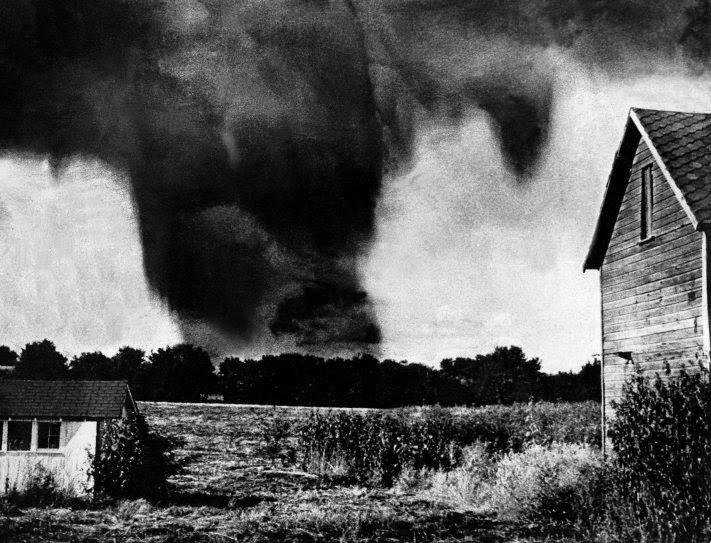
This excerpt is about a storm that sprung up quickly on the vast grassy plains.

"But shortly afternoon, an innocent little day cloud appeared in the southwest and as we watched, it took on a sinister appearance.  We could see flashes of lightning bolts outward from its dark, mass, and as a towering thunderhead mushroomed upward, this cloud spread laterally with amazing rapidity.  It quickly blotted out the sun, and as it did so its color became an ugly dark green.  Tattered segments of cloud tumbled in a mighty rolling motion: while wisps of vapor, which had the appearance of smoke, rolled in an upward sweep across the face of the storm.  As this disturbance approached, a large flock of long-winged, pigeon-size birds wheeled and darted overhead in what appeared to be mad ecstasy or sheer panic, as they drove steadily before the oncoming storm.  These were the insect-feeding creatures of the whippoorwill family, which mother called night-hawks and father called bull-bats, but which the Indians named thunder-birds, because of their habit of acting as heralds of violent weather.

But we had little time to view this awe-inspiring spectacle, for everything had to be piled into the wagon and a tarpaulin stretched over the open front, to turn what was certain to be a driving rain.  Father quickly drove stakes into the ground by each wheel and anchored the spikes into the ground by each wheel and anchored the spikes to these because a heavy gust of wind might have upset the outfit.  The farmer came racing out and told us all to run for the shelter of the cellar, while he and father led the horses into the barn.  Mother hurried the children and Daisy carried Iona; and we all stumbled into the safety of an underground structure, which served as a cooler in the summer, and a frost-free storehouse in the winter, but in this case a cyclone cellar.


Tornado in Nebraska; photograph courtesy of the National Weather Service

By the time the men had joined us, a funnel-shaped tongue had dropped from the cloud; and as it touched the ground, dust and loose objects seemed to leap upward and disappear in the whirling mass.  It was perhaps a mile from our shelter but we could clearly see its rotating cone coming straight toward us.  There was scarcely a stir of air and an ominous silence oppressed us.  There was a crash of thunder and a few spatters of giant raindrops slapped the ground.   Father waited outside for a moment, watching the wild thing with evident fascination until, at the insistence of our host, he ducked into the shelter and slammed the door.  Then in a matter of seconds, this terror was upon us with the roar of a freight train.  We expected to hear the crash of falling buildings and braced ourselves for the blow.  There was a hissing, rending sound, which was smothered by a deluge of rain and hail and a pall of darkness fell over the whole scene.  We had put out the candles for fear they might start a fire, in case the house overhead should be wrecked."

This is my entry for Amy Johnson Crow's 52 ancestors in 52 weeks challenge optional theme Stormy Weather.

_______________
Clarence Mern Beard was born on 7 November 1885 in Ansley, Nebraska, to William Adam and Emma Elizabeth (Elison) Beard. He was their second child and oldest son. He married Helen May Banker, the daughter of prominent Louisiana businessman, Francis Henry Banker, on 30 May 1912 in Calasieu Parish, Louisiana. The couple had two children. Clarence died on 29 August 1960 in Oakland, California.

AncestryDNA and Finding a New Cousin
The Great Cyclone of 1896
Biblical Plague or Locust Infestation?

Sunday, May 4, 2014

52 Ancestors #18: Biking Across Western Canada in 1930

Ancestor Name:  William Warm

I have blogged about the adventures of William Warm before, which included stealing a train during World War I; he was the husband of my second cousin once removed. William and his family arrived in Canada on 27 August 1927 aboard S/S Seydlitz. With the help of Rev. Emil P. Wahl of the American German Baptist Mission, the family made their way Winnipeg, Manitoba to help harvest a bumper crop of grain in southern Saskatchewan and Alberta. Bill decided to stay and try his hand at farming. After a few years of battling dust storms and other crop failures, Bill realized farming in that area of Canada was not for him.

He took off on 30 July 1930 on the one-speed Opel bicycle he brought with him from Germany and headed for Vancouver to look for his uncle, Dave Janzen. The description of the trip is included in Lucille Fillenberg Effa's wonderful book, Our Schalin Family: 1770-2003. I've included an excerpt here:

"He reached Calagary sooner than expected so carried on to Banff, before stopping for the night beside a river, near the roadside. Bill's slumber under the stars was soon interrupted by a bear attempting to ransack his rucksack. Thankfully, the furry thief was scared off when Bill jumped up abruptly and shouted at it.


Photograph of Bill's Opel bicycle during his trip across western Canada.
Photograph taken by William Warm

West of Banff, he headed south through the Windermere valley to Cranbrook, then west to Creston where he crossed the Arrow Lakes by ferry, at a cost of $0.05. Leaving Nelson, he continued his journey pedaling through the West Kootenays. Arriving at the foot of the 12-mile long hill outside of Rossland a kind soul in a Ford touring coupe stopped and offered him a rope tow. Bill accepted the offer but made the mistake of tying the rope to the spare tire on the back of the car. His second mistake was tying the other end to the bike's handle bars. Up, up, up they went through many switchbacks, before reaching the crest of the hill -- at least a half hour's grind. But as the law of gravity would have it, what goes up soon comes down -- rapidly. Bill, pell-melling behind, shouted for the driver to stop. He did. But Bill zoomed right on by, only coming to an abrupt halt in the ditch when the rope length ran out and snapped. After picking himself up, he immediately noticed the bicycle wheel now in the shape of a figure eight. What to do? He took the wheel off, picked it up, and bent it back into shape across his knee, reinstalled the wheel and carried on, declining an offer for further towing.

Interesting escapes weren't yet over. Upon arriving in Grand Forks, Bill was greeted by a bevy of stark-naked ladies protesting something as they paraded about the town trying to make a political point. Thankfully, this occasion was not planned for Bill so he kept on pedaling by, leaving the local RCMP officers to handle the problem presented by a group of Russian Doukabour 'mommas.'

Bill eventually arrived in Vancouver but still had to find Uncle Dave, without an address nor a phone number, but knew he lived on Lulu Island somewhere. Bill remembered having seen an advertisement for the Ebenezer Baptist Church in the German magazine Der Sendbote. He found the church on 52nd Avenue near Fraser Street. As it happened the pastor, Rev. Fred Mueller (son of Rev. F. A. Mueller[1]) knew Uncle Dave and directed Bill to his home.


William Warm and his Opel bicycle

Thus ended Bill's long journey sometime in August 1930. He averaged over 70 miles a day, and more amazing, never had one flat tire."

This is my entry for Amy Johnson Crow's 52 ancestors in 52 weeks challenge.

_______________
William Warm was born on 13 Dec 1909 at Millirowa, Russia, to John and Helen (Janzen) Warm. After being displaced several times during World War I and afterwards, the family arrived in Nova Scotia, Canada, aboard the S/S Seydlitz on 27 August 1927. William married Norma Viola "Minnie" Grapentine on 6 October 1936. He died on 26 Aug 2007 at the age of 97.

To read more about William Warm's early life and journey from Odessa to Vancouver, including stealing a train, click here.

[1] Rev. F. A. Mueller was the German Baptist minister responsible for bringing several families from the Volhynia region of what was then Russia to the Leduc area of Alberta, Canada, including my maternal grandmother's Schalin family.

Sunday, April 20, 2014

52 Ancestors #16: A Wanderer Returns

Ancestor Name: John Andrew Riggin

Oh sure, old newspaper archives are great for finding your ancestors' obituaries, marriages, birth announcements and social activities; but did you ever look for more than those typical "black and white" facts when searching through musty archives, old microfilm rolls, or online indexes? I have found so much "gold" in these articles that I've added a step to my research process to include hunting down newspaper archives in the places my ancestors lived.

Clementine Wells was my great great grandmother. She married twice, was widowed twice, and had at least six children. The Wells branch of my family tree has been tough to trace, but that's a story for another day. The Troy Weekly Call archive yielded just the color I love about John Andrew Riggin[1], one of Clementine's sons:

Troy Weekly Call 17 Sep 1904

John Riggin, of this City, Who Has Sailed Almost Around the World, Tires of Sun Life and Returns
John Riggin, a son of Mrs. Wm. Collins of this city, returned last Saturday from San Francisco and arrived in Troy Sunday for a visit of a few days with home folks.

Since last leaving Troy about two years ago young Riggin has traveled almost around the world as a sailor and has acquired some valuable experience. He first enlisted as a sailor on an American sailing vessel at Portland, Ore., and went to Cape Town, South Arica. There he enlisted on a German ship of the same kind and went to New Castle and Sidney, Australia. The crew was shipwrecked of the coast of Sidney and picked up by a tug. He then went on an Italian sailing vessel and on account of the hardships and starvation to which he was subjected, was among a number to desert the vessel leaving several months' pay behind. On the Hawaiian Islands he went on another American ship which finally landed him at Tacoma, Wash.


Young Riggin says a sailor's life is a dog's life and he wants no more of it, but would take nothing for the experience and sightseeing has had had. He has secured a position with the Heydt bakery in St. Louis and how proposes to settle down.


Yes, the article contained and confirmed some genealogical facts:  1) Clementine Wells remarried after her first husband died to William Collins, 2) John Riggin was her son, and 3) Clementine Wells lived in Troy, Illinois -- all things I already knew. But unknown to me was the character and life experience of John Riggin. This articles provides a taste of both.

What interesting things have you learned about your ancestors in old newspapers?

This is my entry for Amy Johnson Crow's 52 ancestors in 52 weeks challenge.

_______________
[1] John Andrew Riggin was born 15 October 1881 at Madison County, Illinois, to John Wesley "Wes" and Clementine (Wells) Riggin. His father died 5 months before he was born. He moved to Oakland, Alameda, California in 1909 and married someone named Alice on 19 October 1909. He died on 3 Jun 1970 at San Jose, Santa Clara, California. I do not know if he and Alice had children as none were ever listed on the 1920, 1930 or 1940 census.

Friday, September 13, 2013

Trip Around the World: Kenya to the U.S. (the Asian Route)

William Judkins Bailey took his family to British East Africa (Kenya) in 1920(1) so he could be a missionary there for the Church of God. Their oldest boy, George, returned to the United States in 1924. His next oldest sons -- Homer and Paul Orrin -- returned to Indiana in 1927. The rest of the family traveled through Asia in 1929, including their youngest daughter, my Aunt Joan, who was born in 1921 at the Kijabe Mission Station. Maxwell Bailey was 10 years old at the time the family returned home. This is his description of the trip from his journal, which he wrote several years later:

Nairobi, Kenya, to Troy, Ohio in 1929

We arrived in Torch, Ohio in late 1929. Six months for the journey and all the visits along the way probably is not to far off. A train ride of approximately 300 miles with many stops and layovers from Nairobi to Mombasa could take at least two days. The voyage on the S/S Alora from Mombasa to Bombay, with a stopover at Poorbundy, a day's sail northwest of Bombay, would have taken most or all of a week.  Often after one is safely on board a ship, there could be a couple days of additional loading of freight. A scheduled departure time just wasn't the way it was done.

In Bombay, we visited many places. The most memorable was the Tower of Silence. The Parsees of Bombay believe the human body is sinful and defiled. The earth must not be polluted by burial. Fire is pure and sacred. The body must not be cremated. Hence the tower. The tower is 14- or 16-feet tall and perhaps 40- to 50-feet in diameter with a small door on one side and no roof. Bodies of men are placed along the outer row, women in the middle row, and bodes of children are in the middle. A deep pit is in the center of the circle. Hundreds of vultures clean the bones and scream at each other as the glide through the sky and roost along the top of the tower. The Tower of Silence seemed like the noisiest place on Earth to me!

Tower of Silence in old Bombay

We traveled across India by train. At each stop, at least one man on the station platform walked by the open train windows announcing, Chi gerram, chi gerram -- coffee. He has a large urn and tin cups and for a price, coffee is available.

Monkeys are sacred. No one denies a monkey anything. They will enter the train by the open windows and leave via another window further down the car. En route he may have picked up ladies handbags or anything of value not closely guarded. His owner is a bit richer.

We arrived in Agra about 2:00 a.m. Daddy hired a rickshaw, or two-wheeled conveyance pulled by a man, to take us out to Taj Mahal. He bribed the guard and we finished our nights' sleep stretched out on the marble window sill on one side of the building. When the sun rose, we greeted it from the top of one of the minarets that stand guard at each corner of the main platform upon which the structure rests.

Taj Mahal in Agra

Calcutta is certainly one of the larger, if not the largest cities in India. There are people everywhere, turn as you may, people and more people. Everywhere in Calcutta one would see temples of worship. The show is continuous, hour after hour.

Temples of Calcutta. Photo courtesy of the Metropolitan Museum

From Calcutta we made a side trip to Cuttack. This city had been a swamp at one time, inhabited by alligators or crocodiles. Dead babies, live girl babies, any unwanted babies were tossed in. Some imaginative group filled the swamp and on the fill ground built the Shelter. When we visited, there girls of all ages there, sitting on a long porch waiting with their rice bowls for a meal.

We boarded the S/S Takada for the trip to Singapore. Word was passed through the ship's passengers that pirates had attacked the ship ahead of us but we never saw any pirates.

From Singapore we traveled to Hong Kong. I don't believe it to this day, yet I saw it. A Chinaman had his children -- two little boys and a girl -- standing on a long, low bench. Their arms stretched out towards each other and head tilted back so far that teacups could be placed in each hand and forehead. Tea was poured in all the cups. By pure magic, it seemed to me, their feet, firmly on the bench. They leaned back further and further until they were horizontal. Then yet further back until the back of their heads were on the dock. Slowly, they moved back to a vertical position and never a drop of tea was spilled! Of course, coins showered to the dock from the ships' passengers.

We ascended Victoria Peak by cable car before traveling by train to Shanghai. We all learned to use chopsticks there. Father made sure of that. The walls of the houses were made of oiled paper over wooden frames. Since earthquakes are very common, a house built of light materials would do its occupants less damage than heavier ones.

Hong Kong Funicular

From Japan we boarded the S/S Paris Maru, a cargo ship bound for Seattle. I was in my element and all over that ship! One of the crew members had a small radio. I'd never seen one before. Pure magic!

S/S Paris Maru

In Seattle we stayed with my mother's sister's family for awhile before heading by railroad to Chicago. Then a relatively short train ride to Anderson, Indiana, where we attended a reception in the Anderson College and Training Seminary chapel. Another train ride and we were in Torch, Ohio, where my father's brother was the pastor of a local Methodist Church. We settled there on a farm.

_________________
(1) To read about the Baily family's 1920 trip to Kenya, click here and here.

Wednesday, September 11, 2013

Wordless Wednesday: 1929 Travel Scene

I hope you are enjoying the series of posts about traveling around the world in the 1920s. I have so enjoyed reading Homer and Maxwell's Bailey's journals and researching their trip to British East Africa, now Kenya.

Here is a scene from their trip:

Bombay in 1929. Photo courtesy CSMVS, Mumbai via Outlook Traveler Magazine

The idea for this post came from Geneabloggers.com

Monday, September 9, 2013

Trip Around the World: Egypt to Kenya

Aunt Joan was born in Kenya in 1921 to a missionary parents. Her brothers, Homer and Maxwell, wrote journals, which a very kind lady sent to me recently. This post is the about the second half of the family's journey to Kenya and was written by Homer, who was 13 years old at the time of the journey. You may read about the first half of the outbound journey here.

Anderson, Indiana, to Kijabe, Kenya in 1929

Our ship pulled up anchor in Egypt and we steamed through the Suez Canal. Miles and miles of desolate sands. True some of that country is less than thrilling. I was surprised to learn, however, that there were connections between the Mediterranean and the Red Sea in ancient times. In those early days the Nile Delta reached as far as Zagazig whence a fresh water canal led to Lake Timsa. The canal from Lake Timsa to the Red Sea was commenced by Necho in 600 BC and was completed a century later. It fell into decay but was restored by Trajan and again later by Arab rulers. Napoleon considered the possibility of restoring it as well, but it wasn't until 1856 that Frenchman Ferdinand Lesseps workable plans for the present day Suez Canal.

Port Said, entrance to the Suez Canal circa 1900-1920. Photo courtesy of the Matson (G. Eric and Edith) Photograph Collection

Aden stands on a wild, rocky peninsula on the south coast of Arabia. A number of minarets stand tall above the city and long before dawn, the call to prayer echoes over the city. Always I have found seaports intriguing. I love to listen to conversation even though I know not a single word. The ways of other nationals and their customs I find simply fascinating.

Names such as Massawa or Mogadishu and Kismayo have a nice feel as they roll off the tongue. These are port cities along the East Somaliland shores. Our ship had tons of freight for these places. Days in port gave us the opportunity to see the local sights. We took a ride in a small boat having a some sort of boxes arranged along the side with glass bottoms so as to better view the shells and coral reef. It is my own belief that those were the most wonderful coral reefs I've ever been privileged to behold. Talk about colors...well, all the colors of a rainbow were there and simply magnificent.

Mogadishu in 1936

Two islands just off the mainland -- Massawa and Taulud -- are joined by an embankment. These form a large sheltered harbor. Our ship anchored there. A massive steam engine was lifted off the deck, swinging over the side. It was slowly lowered onto a small barge tied along side. That seemed a dangerous job for all involved. A sling containing gas cylinders lowered over the side missed the barge completely. A sailor placed some coal in a sack, attached a cord, and lowered it to the bottom, leaving a floating marker.

Fronded palms wave a welcome as you approach the lovely tropical island of Mombasa. It is a most interesting city as it spreads out over the island. When we arrived we dropped anchor out in the bay. There was no pier so all passengers and freight were moved by small boats from ship to shore. Native porters handled the trunks and suitcases. The boatmen dickered with individuals or families as to fare.  The small boat landed us by the custom house steps in late afternoon. Many were given a thorough going over but for us it was quite brief. We were on our way to the rail station and passed native homes all properly roofed with makuti or palm leaf shingles. Little near naked babies and children were out playing in the yards. Women were busily preparing the evening meal.

Mombasa is richly endowed with beauty. Stately palms flutter in the breeze as just beneath them hang the clusters of coconuts. In groves the gracious green mango trees stand tall loaded with luscious fruit. Other strange fruit trees were the guava and loquat. Never before had we seen bananas. Here they were with mammoth blooms, great clusters ripening on the stalks.

Mombasa. Photo courtesy of mwambao.com

The evening train was loading when we came onto the platform. First class was already full. Second class was full as well. Third class was generally used by local people. Father decided we were going third class. The seating was not upholstered, just bare furniture, easily cleaned. These accommodations were purely for utility not comfort. What a simply delightful time as the shrill whistle announced "all aboard." With steam escaping from the locomotive, people waving farewell, some running along the platform, the long train slowly moved out.

Come dawn we were miles from the sea, chugging steadily for the highlands. Later we learned we had passed through thorny forests as well as miles of scrub brush, inhabited by elephants. At Makindu, over two hundred miles inland, the wilderness gives way to great wide open plains. Some of that region is quite dry except during monsoon season. From that point to Nairobi we saw thousands of wild animals of many kinds. It is surprising to me that these beasts, though close to the tracks and the noisy train, seemed unafraid. Our train stopped a few times for wood and water but few passengers left the train until we reached Nairobi.

At the gates of the railway station a broad street leads straight to the heart of the city. Motor cars and taxis were there as well as the man-drawn rickshaws. The contrast between the different races were obvious. The Akamba people sharpened their front teeth and the Luo extracted some of the front lower teeth. The hairdos were equally interesting and very intricate. The use of caster bean oil with red earth pigment coated some people's entire head.

Nairobi in the mid 1920s

We returned to the train to travel to our final destination. The highlands are like a great, wonderful park land. Great deep gullies were bridged by strong girders of steel suddenly changing the sounds of the passing train. We scurried across several trestle bridges high above chasms in which flowed small creeks. To the left was a view ending in the distant horizon of the Masai. Crossing a wide high bridge the train slowed to a stop and we were at Kijabe.

Train on the Ugandan Railway (the same rail line on which the Bailey family traveled) circa 1910

The African Inland Mission is a place of beauty nestled among the lovely forest trees. at the time I think there were some ten homes as well as the church, a hospital, and schools. This was our new home.

Friday, September 6, 2013

Trip Around the World: New York to Egypt

In 1920 the William Judkins Bailey family traveled to British East Africa, now Kenya, to be missionaries there for the Church of God.  This post is from Aunt Joan's brother, Homer's, journal and is his description of the first leg of their trip from New York to Kenya. Homer was 13 years old when the family made the trip.

From Anderson, Indiana, to Kijabe, Kenya

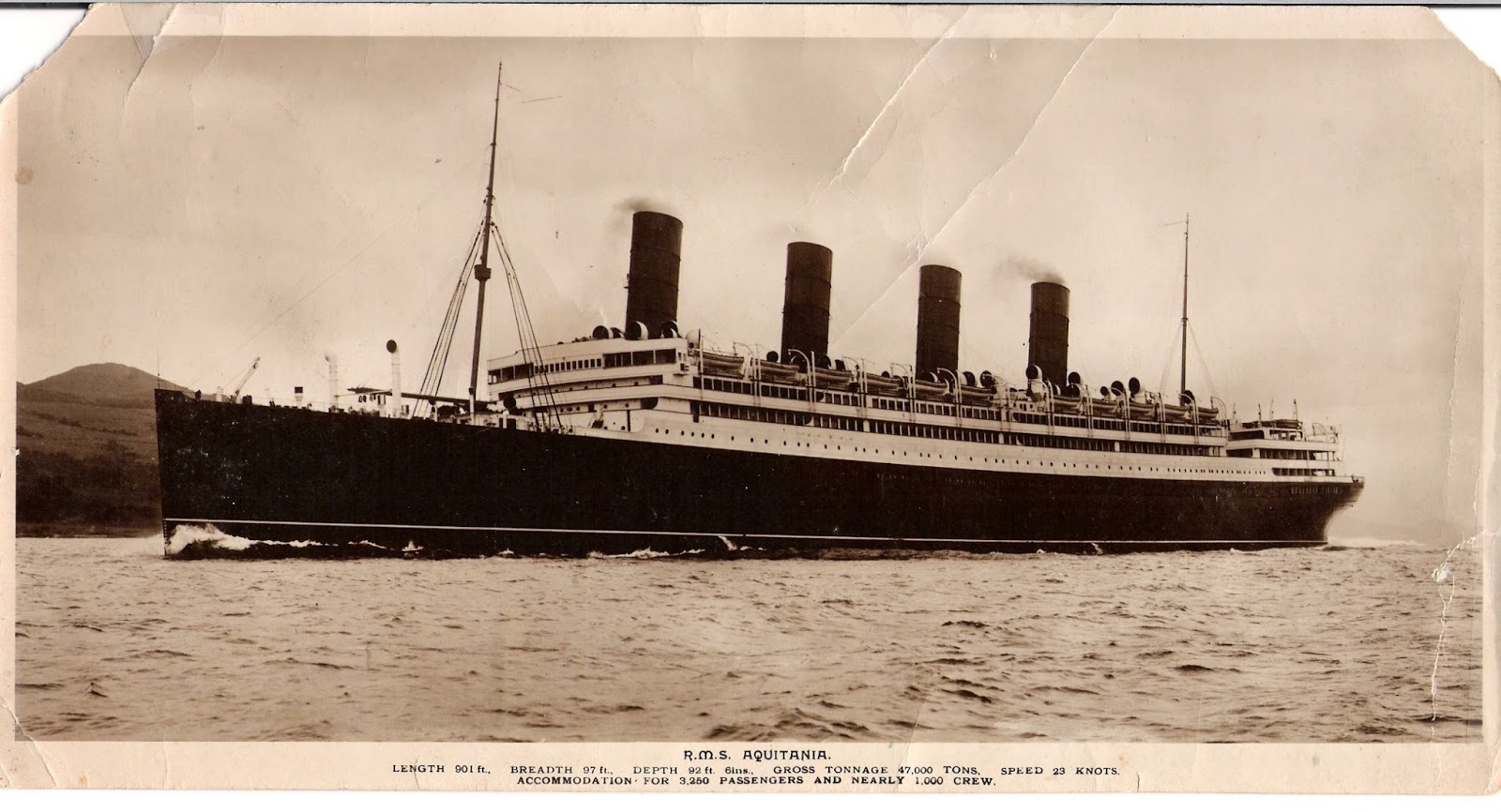
Following World War I, before the dust was settled in certain areas, such as the near East, my folks packed up what to them seemed the necessary belongings and left for Africa. We sailed away from these shores on board the RMS Aquitania out of New York one midnight in June 1920.

RMS Aquitania

The decks of the Aquitania were really roomy. There was something of wonder every place you looked; each stairway led to a new discovery on that magnificent city of the seas. It was like three hotels at least but floating along at considerable speed.

Southampton, England, was our first real stop. That was where our knee-buckled 1918 breeches were labeled "girl garments" by the local boys. We stayed just a day or two and then embarked on the Channel ferry late one evening. When morning dawned we were at the docks in Le Harve, France.

Getting the suitcases off the ferry and to the train station took some doing, but soon we were chugging our way to Paris. I found myself gawking at the sidewalk urinals.

Paris urinals

We didn't stay in Paris long as we had a ship to catch in Marseilles. This ship was old and tired; it's very name eludes me. The name painted on all the usual places was Greek. I will never forget the giant sized cockroaches jumping about among the pots and pans in the kitchen.

Marsailles, France

When we arrived in Egypt, two mules towed the tram car which whisked us along in Cairo. What a city; what a ride! Palm trees were quite new to us. Local people, dressed in flowing robes and turbans, were sitting on the sand by show cases or large trays of dried figs, dates and cakes or coffee. Along some of the streets there were continuous awnings for blocks on end. Men would sit at tables under these awnings and have coffee or play dominos or checkers. Life seemed sort of leisurely.

After leaving Egypt, we sailed to Jaffa, Palestine, and then journeyed to Jerusalem, riding our first narrow-gauge rail train. It was also our first experience with the class system -- first, second and third class coaches. A large crowd gathered to get on the train. There were turbaned gentlemen, veiled ladies, robed Arabs, as well as an assortment of other nationals. Ragged folks, well dressed folks, some ancient and some very young were all eager to be on the train. When it came some people hoisted luggage and friends through windows, they guarded doors to keep out the invasion, saving space for themselves. Conditions were not at all orderly. What a scramble!

Volumes could still be written about Jerusalem that ancient, historical, political, religious, old yet new city. A city destroyed, rebuilt, burned to the ground, resurrected, broken to rubble and still it stands on those memorable hills -- the city of David, the city of Solomon. Oh what a city!

Jerusalem wheat market, 1920

In Jerusalem we engaged a vehicle resembling an old Western stage coach for the run down to the Dead Sea. By the shore we saw a number of excavated squares some two or three feet deep. A small ditch connected each square to the sea. By this method each square was filled with salt water, sealed off, and evaporation left a cake of salt.

Auto on the Dead Sea beach circa 1925. Photo courtesy of ynetnews.com

The present Jericho contains but a few buildings. One of the more outstanding was the Hotel Jericho. The walls are painted white and the roof was made of vivid red tile. Mosquitoes were numerous and we slept under netting for the first time.

We walked many miles the day we went to Nazareth. There was war then. Heavy gun fire could be heard in the distance. Traffic was almost non-existent. A military truck came along and gave us a lift. We were taken across the Sea of Galilee in the commander's motor launch. Due to the general unrest in the area, he urged us to spend the night in his military camp. So we had a tent, camp beds, and all the comforts of home.

Syrian soldiers during the Franco-Syrian War

Our wandering from place to place in the Holy Land was halted by the war action between Galilee and Damascus.(1) We saw many large shells along the roads. The three weeks allocated for our visit to the Middle East seemed all too soon gone. There was so much more to see and a lot we would have to remember.

Next for our family was to return to Port Said and our ship.

This leg of the journey will be continued in a future post.
__________
(1) This was the Franco-Syrian war which took place between the Arab Kingdom of Syria and France in 1920.

Monday, August 19, 2013

A Trip to Paris

I've written about Edith Mary Madeline Ternes before: here and here. Edith is communicating via voice tapes to a relative named Sofee, who is also interested in researching the Ternes family. They trade information and photos and, as you can see, information about themselves:

What a delightful dream you have of Paris. When I read that I was reminded of Henry Van Dyke's poem, "America for Me." In describing London and Paris about half way through the poem he said, "Oh, London is a man's town, there's power in the air and Paris is a woman's town with flowers in her hair."

Henry Van Dyke. Photo courtesy of RightWords.com

Yes, I went to Paris. It was one of the stops of a 49-day tour of the continent. We visited 7 countries and found them all fascinating. No doubt there have been many changes since that summer of 1954 but I still remember the highlights. It was like walking in a dream through places I never expected to see. I seemed always on the alert for fear I would waken in my bed at home. There were Montmartre, Maxim’s, Folies Bergere, Bois de Bologna, Sainte Chapelle, the Left Bank, Notre Dame Cathedral, the palace of Versailles and the Louvre with its haunting Mona Lisa. These things I remember vividly and would like to see again.

Maybe I had better make another promise to myself. One of our assignments when I was in the eighth grade was to make a promise and write about it. Our teacher was way ahead of her time and a wonderfully imaginative person. She said, "A promise made is a debt unpaid so make a promise to yourself and you will surely keep it." Along with my classmates I very solemnly made twin promises to myself - first that I would be a school teacher and second that I would go to Paris someday. My teacher was right. I did keep my promises to myself. Seven years later I began a teaching career which lasted for 47-1/2 years but it took me 36 years to get to Paris.

Paris Metro -- Ternes Station. Photo courtesy of  www.cparama.com 

I made it and loved it just as I had expected I would. I stood on the sidewalk in Montmartre and hugged myself I was so delighted to be there. It was on the way back from the Bois de Boulogne that I saw the street sign with Pont de Ternes on it. It is pronounced Tern but spelled Ternes. The people are French. The next day I passed up a luncheon at the Eiffel Tower to walk back toward the Coq Hardee restaurant where we had lunch the day before in hope of finding that sign and taking a picture of it. I did find it. I hunted up a policeman or gendarme and asked him about it. My inexcusable French forced me to write my questions which he answered for me. He told me the area and the street were named for a very old family who lived there. I should have tried to locate someone named Ternes in the phone book or through the gendarmes. When I came home I learned from a cousin that some researcher had found out that one of the Ternes men, who fought in the German army during the Franco Prussian War, fell in love with a French girl, married her and settled down in France. You see there is some romance in our history.

Avenue des Ternes, Paris, France. Image courtesy of www.notrefamilies.com

In a later tape:

I think I am on the trail of something now. Louise, my cleaning lady, has a brother living in a suburb of Paris and she has written asking him to try and get me the pages of the Paris telephone book with the name Ternes on it. If I get them I shall try to communicate with some of them and see if they know where their family began. My French is inadequate but I am sure someone will help me out. How is your  French? Maybe you would like to write too.

And still later...

Louise just called and gave me three addresses for people who are named Ternes and live in Paris. One is a corsetier, one a furniture mover and one an automobile dealer I think.

And, again in a later tape...

Louise called and gave me four Ternes businesses listed in the Paris telephone book. One is Ternes Immobiliers or furniture movers at 1 Rue Ne'va in the 8th district. Ternes Tapis Maquettes (Textiles) 4 Rue Ville Bois 17th District Ternes neg a cious cions d'automobile 71 Boulevard Gouvion St Cyr; 7th District and Les Ternes Corsetts at 37 Avenue McMahon 17th District. I think I will try a little strategy on them all. I will send them pictures of their name on the street signs of Dearborn and possibly one of the large grave marker in the cemetery. This may arouse a little curiosity in them and they may respond.

It was obviously much harder to research your genealogy without the Internet!