Wednesday, August 31, 2016

History Everywhere! Finding a Confederate Spy

I recently had to get an oversized document scanned. So I went to the closest copy center which had a scanner big enough, which was in the Worldgate Centre, a shopping, office and hotel plaza in Herndon, Virginia. As I was leaving I remembered the grave of a famous Confederate spy was supposed to be somewhere on the grounds of the plaza.

And sure enough, just across the parking lot from the hotel entrance I spotted a historical marker and small fenced graveyard in the middle of a grove of large holly trees.

Laura Ratcliffe historical marker at Worldgate Centre, Herndon, Virginia;
personal collection
Grave of Laura Ratcliffe; personal collection

Laura Ratcliffe was known as a local beauty. Among her many admirers was J.E.B. Stuart, a Confederate States Army officer during the Civil War.

Laura Ratcliffe; courtesy of the Stuart-Mosby Historical Society

Laura was born on 28 May 1836 in Fairfax City, Virginia, to Frances Fitzhugh Ratcliffe and Amy McCarty Lee. She was a 6th cousin of General Robert E. Lee. After her father died, her mother and two sisters moved to Frying Pan (which is now part of the Town of Herndon).

Merrybrook, home of Laura Ratcliffe during the Civil War. The home is one
the grounds of Arrowbrook Park but is privately owned and currently occupied;
personal collection

Laura met James Ewell Brown (JEB) Stuart when she and her sister were nurses in at his winter camp in 1861. She is also said to have saved the live of Colonel John Singleton Mosby, leader of Mosby Rangers and known as the Gray Ghost. He stayed at the Ratcliffe home whenever he was in the area.

Mosby Rangers fought a guerrilla war with small detachments attacking the enemy behind their lines and then disappearing into the country side. They also disrupted communications and transportation. Laura would learn about Union military activity in her area and leave Mosby messages under a rock on Squirrel Hill, a part of the Ratcliffe's property. She saved his life when she communicated to him that the Union Army were planning on setting a trap for him near her home. A Union Army officer described her as a "as a very active and cunning rebel, who is known to our men, and is at least suspected of assisting Mosby not a little in his movements."

After the war Laura married a Union veteran, Milton Hanna. During her lifetime, Laura never received recognition for her role as a Confederate spy. She died on 8 August 1923 at Merrybrook, her home (photo above). Among her personal effects an album of poems was found. There was an inscription which was signed by JEB Stuart and several of his officers, which read:

"Presented to Miss Laura Ratcliffe by her soldier-friend as a token of his high appreciation of her patriotism, admiration of her virtues, and pledge of his lasting esteem."
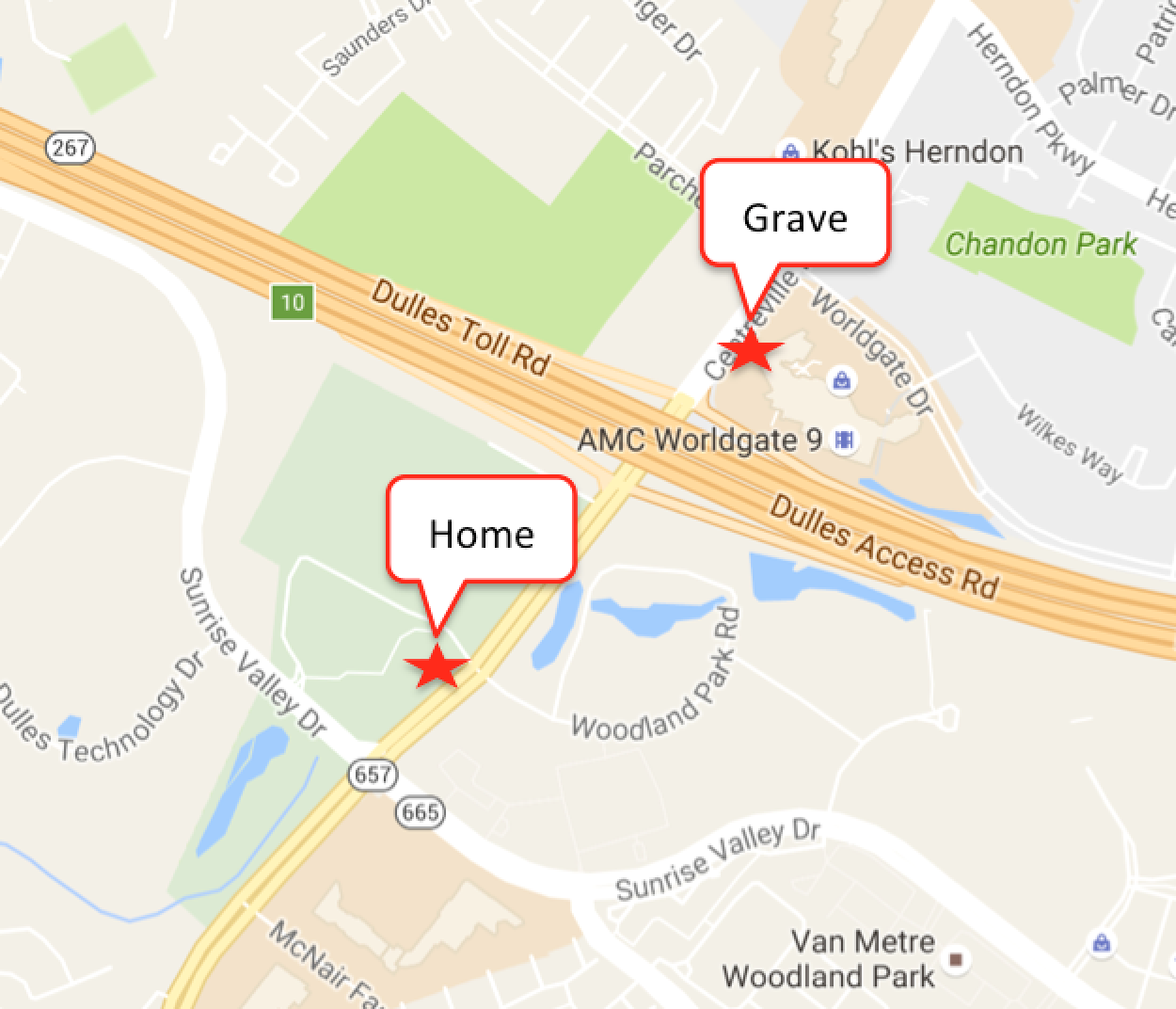
Map of the Centerville Road-Dulles Access/Toll Road interchange in Herndon,
Virginia; Google maps modified using Microsoft Powerpoint

_______________
Civil War Guerrilla Partisans: Mosby's Rangers

Monday, August 29, 2016

The Rice Family: Lost at Sea

A couple of my DNA matches confirmed that Rev. David Rice (1733-1816) was my six times great grandfather. He was a prominent man in the Virginia colony, the nascent state of Kentucky, and the Presbyterian Church. He was also an early, strident abolitionist and he was often called the "Apostle of Kentucky." He was written about often and I have collected digital copies of several books which include biographical sketches, his involvement in education and religion or his family's history in the colonies. Those books indicated a Thomas Rice, Rev. Rice's grandfather, was born in England but was an "early adventurer into Virginia." But I had never researched the generations which preceded Rev. Rice.

Interestingly enough, my brothers did not share any DNA matches with Rev. Rice as the common shared ancestor. When my 89-year-old uncle's test results were available, that changed. My uncle currently has 11,800 DNA match results. As a comparison, I have 6,600. Nearly 150 of my uncle's matches include the surname Rice in their family tree. Not only did he share most of the matches I had, he also had several where the common shared ancestor was Rev. Rice's grandfather, Thomas Rice.

So it was time to see what information I had already collected about the early Rice line and develop a research plan for Thomas. I am still working on that plan, but I wanted to share with you a brief sketch of his family history, which I discovered in A History of St. Mark's Parish, Culpeper County, Virginia, by Rev. Philip Slaughter, which was published in 1877. That book contained a direct quote from memoirs written by Rev. David Rice.[1]

Title page of A History of St. Mark's Parish, Culpeper County, Virginia by Rev. Philip
Slaughter, and published in 1877; courtesy of Internet Archive

"Thomas Rice was an Englishman by birth, of Welsh extraction. He was an early adventurer into Virginia; where he spent the first part of his life is not certainly known. In the latter part of his life he owned a small plantation in the lower part of what is now (1824) called Hanover county. Here he left his wife, with nine sons and three daughters, and went to England to receive a considerable estate which had been left him, but returned no more. The sailors reported that he died at sea. It is supposed that he was assassinated. No return was ever made of the property after which he had gone, and his family were left destitute in a strange land.

The family being left without an earthly father, were distressed, but they were, in the good providence of God, provided for. The greater part moved about thirty miles farther up the country, where they procured a small plantation, on which they raised numerous families; four or five of them became professors of religion, and were succeeded in their religious profession by a considerable number of their children."

_______________
[1] I have purchased but not yet received A History of the Church in Kentucky for Forty Years, Containing the Memoirs of Rev. David Rice by Robert H. Bishop, published in 1824.